The Equal Ticket Fallacy: How High-Performing MSPs Think About Support Capacity
Feb 12, 2026


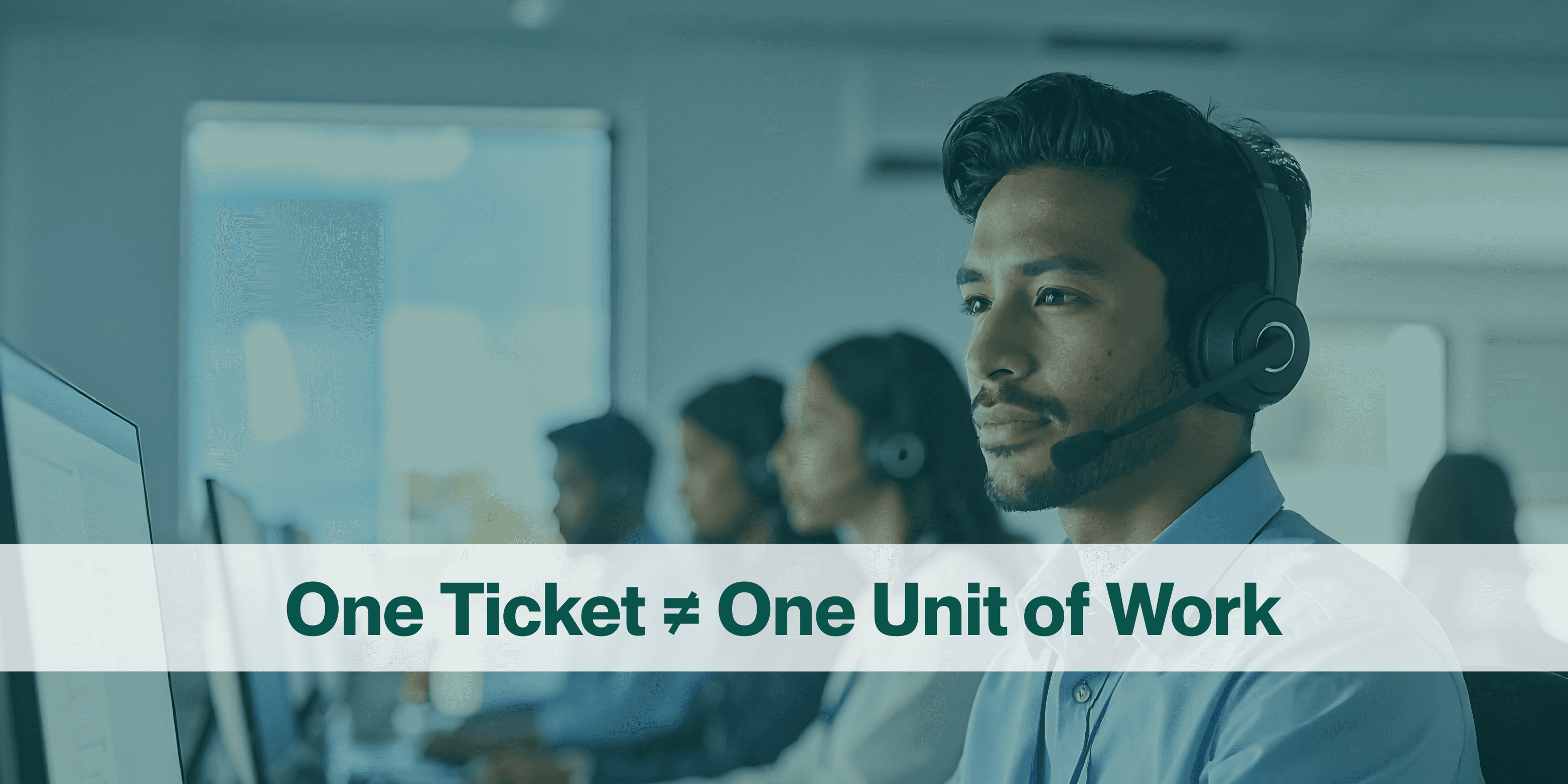
For decades, ticket volume has been treated as the primary indicator of workload. More tickets means more staffing. Fewer tickets means more efficiency. One ticket equals one unit of work.
It is simple, clean, easy to track, and fits neatly into dashboards and reports. It also quietly distorts reality.
Internal IT studies show that ticket handling time can vary widely between simple and complex requests (Zendesk, Giva), yet most service models still treat every request as interchangeable. A five-minute password reset and a forty-five-minute application failure both appear as "one ticket." On paper, they look equal. In practice, they are anything but.
On a 1,200-ticket month, that hidden variance can represent more than 200 hours of unplanned labor (Evolved Management). Time that no pricing model, staffing plan, or growth forecast accounted for.
Two hundred unplanned hours is not operational noise. At a conservative fully loaded engineering cost of $60–$80 per hour, that represents $12,000–$16,000 in unmodeled labor in a single month. Over a year, that is $144,000–$192,000 quietly absorbed into margins.
And that assumes the work stays internal.
Those hours are senior engineer time pulled from projects, revenue-generating initiatives, and strategic improvements. The cost is not only labor. It is an opportunity.
High-performing MSPs do not ignore this. They design around it.
In this blog post we will share that design with you:
How to reframe support from ticket volume to load management
Why high-performing leaders measure variability, not volume
A practical framework to structure for variability
How to shift the modern MSP mindset toward a living system design
Reframing Support: From Work Processing to Load Management
On this week’s episode of The Cool Kids Table Podcast, our guest, William Pote of eTop Technology, made an observation that cuts to the heart of this issue:
Most teams are so busy fighting fires that they never stop to redesign the building.
In traditional service models, support is framed as work processing. Tickets arrive. Engineers resolve them. Metrics track speed. This system rewards throughput. It also hides discrepancy.
Modern MSPs frame support as load management.
They care about:
Where demand originates
How it moves through the organization
Where it accumulates
Where it breaks down
This is a fundamentally different mindset.
Instead of asking, “How fast can we close this?” they ask, “Why did this reach us in this form?”
Instead of asking, “Who can take this next?” they ask, “Why does this require a handoff?”
Instead of celebrating high closure rates, they celebrate declining friction.
Support becomes an intelligence function, not just a response function.
Most MSPs measure activity.
High-performing MSPs measure signal.
The Leadership Question Is Not “How Many Tickets?”
It Is “How Much Variability Are We Carrying?”
Mature support organizations rarely lead with volume metrics alone. They lead with volatility metrics.
They want to know:
How predictable is our incoming work?
Where does complexity concentrate?
Which tools or processes generate disproportionate friction?
What percentage of tickets behave “normally”?
What percentage require investigation, coordination, or escalation?
These questions reflect a deeper understanding of system performance.
In resilience engineering principles outlined by Erik Hollnagel, a discipline that studies how complex systems remain functional under stress, researchers consistently find that success depends less on average workload and more on how well variability is absorbed at the frontline.
In other words: systems fail not when they are busy, but when they are surprised.
Most mature MSPs find that:
60–70% of tickets are predictable, repeatable work
20–30% require contextual troubleshooting
5–10% consume disproportionate engineering effort
That final 5–10% often accounts for 30–40% of total time spent.
That’s a powerful Pareto effect and completely believable in support environments (Evolved Management).
In resilience engineering, a discipline that studies how complex systems remain functional under stress, researchers find that success depends less on average workload and more on how well variability is absorbed at the frontline.
In other words, systems fail not when they are busy, but when they are surprised.
Support desks operate under the same dynamics. Most outages, backlogs, and burnout cycles do not happen during “normal” days. They happen when variability spikes and the system has nowhere to put it.
High-performing MSPs treat this reality as a design problem. Not a morale, hustle, or staffing problem, but a systems problem.
A Practical Framework: How Mature MSPs Design for Variability
Instead of reacting to workload swings, leading organizations institutionalize three structural disciplines. These are not “nice to have” best practices. They are operating principles.
1. Classify Work by Effort, Not by Label
Traditional ticket systems emphasize category. Mature systems emphasize effort.
They maintain internal effort tiers such as:
Low-friction: predictable, documented, resolved quickly.
Medium-friction: requires context, judgment, or coordination.
High-friction: systemic, recurring, or cross-functional.
This classification allows leaders to see their real workload. It also exposes where improvement investment delivers the highest return.
Rather than viewing an increase in difficult tickets as simply a need for more staff, mature MSPs recognize it as a warning sign that underlying systems or processes need attention.
The signal is not staffing shortages. The signal is system stress.
2. Build Automation Around Stability, Not Speed
William brought up another good point in the podcast when he spoke about automation. You cannot simply look at time to automate versus time to save. Other factors need to be taken into account.
Teams should assess:
How frequently a task is performed
Whether the process is prone to errors or frequent rework
How easily others can follow the established steps
A task performed 10 times per day at 6 minutes each consumes 50 hours per year. Stabilizing and automating that task can return an entire workweek of capacity from a single workflow.
By taking a holistic view of these variables, organizations can make more informed choices about where automation will yield the greatest long-term benefits, rather than focusing solely on immediate time savings. William’s advice sums it up well: “Slow down and pay attention.” He stressed the need for a process first, and K and B Global emphasize that the right foundation must be laid to ensure automation is smooth and efficient.
High-performing MSPs therefore follow a sequence:
Stabilize → Document → Optimize → Automate
Only high stability work qualifies.
3. Engineer “Calm” as a Performance Indicator
Within mature MSPs, a sense of calm permeates the organization. Teams operate with urgency, but there is no panic, only measured and controlled action.
A calm environment emerges when several critical conditions are in place:
Escalation paths are clear and well defined.
In many MSPs, 15–25% of tickets escalate beyond their intended tier. High-performing organizations often reduce that to under 10% (Evolved Management).
Even a 5% reduction in escalations can reclaim dozens of senior engineering hours each month and materially reduce downstream strain.
Documentation is trusted, accurate, and up to date.
Handoffs are kept to a minimum.
Expectations are consistent across the team.
Frontline staff are supported with resources, coaching, and air cover from leadership.
Calm is a system property and, when engineered deliberately, it becomes a reliable indicator of organizational health and effectiveness.
The Modern MSP Mindset: From Counting Work to Designing Systems
Once leaders move past the Equal Ticket Fallacy, their questions change. They start asking, “How do we shape demand?”
This leads to new priorities:
Reducing avoidable contacts
Improving first contact resolution
Standardizing access paths
Eliminating orphaned tools
Aligning vendors to support models
Industry research shows that 15–30% of inbound tickets are often avoidable through better self-service, knowledge bases, or user education, with well-implemented solutions deflecting up to 40% of repetitive requests (eDesk). For a 1,200-ticket month, even a 10% reduction eliminates 120 tickets, the equivalent workload of nearly one full-time frontline engineer annually.
Support becomes governed, not endured. That governance creates lower escalation rates, more stable staffing needs, more predictable margins, and better client experiences.
Growth stops feeling fragile. Tickets are no longer treated as equal. Support is treated as a living system.
Where Helpt Fits: Reinforcing the Operating Model
This mindset depends on frontline stability, where most variability first appears.
Unclear requests. Partial information. Urgent misunderstandings. Off hours surprises.
Helpt functions as a variability buffer. By providing consistent, all human frontline support, Helpt absorbs fluctuation before it reaches specialized engineers.
Without a stable frontline, variability travels upstream. With one, it is absorbed where it first appears. That containment changes the behavior of the entire system.
This creates structural advantages:
Cleaner intake
Better routing
Reduced rework
Protected expertise
Not by replacing internal teams, but by reinforcing them.
About the Author

Editor, Author, Designer & Podcast Visual Producer
Michelle Burnham is a freelance editor, book formatter, and cover designer who helps authors and brands bring ideas to life with clarity, consistency, and visual impact. Her work blends editorial precision with creative design, ensuring every project feels cohesive across words and visuals. In addition to her freelance practice, she serves as a contract graphic designer and visual producer for Helpt and is also a published author writing under a pseudonym.
For decades, ticket volume has been treated as the primary indicator of workload. More tickets means more staffing. Fewer tickets means more efficiency. One ticket equals one unit of work.
It is simple, clean, easy to track, and fits neatly into dashboards and reports. It also quietly distorts reality.
Internal IT studies show that ticket handling time can vary widely between simple and complex requests (Zendesk, Giva), yet most service models still treat every request as interchangeable. A five-minute password reset and a forty-five-minute application failure both appear as "one ticket." On paper, they look equal. In practice, they are anything but.
On a 1,200-ticket month, that hidden variance can represent more than 200 hours of unplanned labor (Evolved Management). Time that no pricing model, staffing plan, or growth forecast accounted for.
Two hundred unplanned hours is not operational noise. At a conservative fully loaded engineering cost of $60–$80 per hour, that represents $12,000–$16,000 in unmodeled labor in a single month. Over a year, that is $144,000–$192,000 quietly absorbed into margins.
And that assumes the work stays internal.
Those hours are senior engineer time pulled from projects, revenue-generating initiatives, and strategic improvements. The cost is not only labor. It is an opportunity.
High-performing MSPs do not ignore this. They design around it.
In this blog post we will share that design with you:
How to reframe support from ticket volume to load management
Why high-performing leaders measure variability, not volume
A practical framework to structure for variability
How to shift the modern MSP mindset toward a living system design
Reframing Support: From Work Processing to Load Management
On this week’s episode of The Cool Kids Table Podcast, our guest, William Pote of eTop Technology, made an observation that cuts to the heart of this issue:
Most teams are so busy fighting fires that they never stop to redesign the building.
In traditional service models, support is framed as work processing. Tickets arrive. Engineers resolve them. Metrics track speed. This system rewards throughput. It also hides discrepancy.
Modern MSPs frame support as load management.
They care about:
Where demand originates
How it moves through the organization
Where it accumulates
Where it breaks down
This is a fundamentally different mindset.
Instead of asking, “How fast can we close this?” they ask, “Why did this reach us in this form?”
Instead of asking, “Who can take this next?” they ask, “Why does this require a handoff?”
Instead of celebrating high closure rates, they celebrate declining friction.
Support becomes an intelligence function, not just a response function.
Most MSPs measure activity.
High-performing MSPs measure signal.
The Leadership Question Is Not “How Many Tickets?”
It Is “How Much Variability Are We Carrying?”
Mature support organizations rarely lead with volume metrics alone. They lead with volatility metrics.
They want to know:
How predictable is our incoming work?
Where does complexity concentrate?
Which tools or processes generate disproportionate friction?
What percentage of tickets behave “normally”?
What percentage require investigation, coordination, or escalation?
These questions reflect a deeper understanding of system performance.
In resilience engineering principles outlined by Erik Hollnagel, a discipline that studies how complex systems remain functional under stress, researchers consistently find that success depends less on average workload and more on how well variability is absorbed at the frontline.
In other words: systems fail not when they are busy, but when they are surprised.
Most mature MSPs find that:
60–70% of tickets are predictable, repeatable work
20–30% require contextual troubleshooting
5–10% consume disproportionate engineering effort
That final 5–10% often accounts for 30–40% of total time spent.
That’s a powerful Pareto effect and completely believable in support environments (Evolved Management).
In resilience engineering, a discipline that studies how complex systems remain functional under stress, researchers find that success depends less on average workload and more on how well variability is absorbed at the frontline.
In other words, systems fail not when they are busy, but when they are surprised.
Support desks operate under the same dynamics. Most outages, backlogs, and burnout cycles do not happen during “normal” days. They happen when variability spikes and the system has nowhere to put it.
High-performing MSPs treat this reality as a design problem. Not a morale, hustle, or staffing problem, but a systems problem.
A Practical Framework: How Mature MSPs Design for Variability
Instead of reacting to workload swings, leading organizations institutionalize three structural disciplines. These are not “nice to have” best practices. They are operating principles.
1. Classify Work by Effort, Not by Label
Traditional ticket systems emphasize category. Mature systems emphasize effort.
They maintain internal effort tiers such as:
Low-friction: predictable, documented, resolved quickly.
Medium-friction: requires context, judgment, or coordination.
High-friction: systemic, recurring, or cross-functional.
This classification allows leaders to see their real workload. It also exposes where improvement investment delivers the highest return.
Rather than viewing an increase in difficult tickets as simply a need for more staff, mature MSPs recognize it as a warning sign that underlying systems or processes need attention.
The signal is not staffing shortages. The signal is system stress.
2. Build Automation Around Stability, Not Speed
William brought up another good point in the podcast when he spoke about automation. You cannot simply look at time to automate versus time to save. Other factors need to be taken into account.
Teams should assess:
How frequently a task is performed
Whether the process is prone to errors or frequent rework
How easily others can follow the established steps
A task performed 10 times per day at 6 minutes each consumes 50 hours per year. Stabilizing and automating that task can return an entire workweek of capacity from a single workflow.
By taking a holistic view of these variables, organizations can make more informed choices about where automation will yield the greatest long-term benefits, rather than focusing solely on immediate time savings. William’s advice sums it up well: “Slow down and pay attention.” He stressed the need for a process first, and K and B Global emphasize that the right foundation must be laid to ensure automation is smooth and efficient.
High-performing MSPs therefore follow a sequence:
Stabilize → Document → Optimize → Automate
Only high stability work qualifies.
3. Engineer “Calm” as a Performance Indicator
Within mature MSPs, a sense of calm permeates the organization. Teams operate with urgency, but there is no panic, only measured and controlled action.
A calm environment emerges when several critical conditions are in place:
Escalation paths are clear and well defined.
In many MSPs, 15–25% of tickets escalate beyond their intended tier. High-performing organizations often reduce that to under 10% (Evolved Management).
Even a 5% reduction in escalations can reclaim dozens of senior engineering hours each month and materially reduce downstream strain.
Documentation is trusted, accurate, and up to date.
Handoffs are kept to a minimum.
Expectations are consistent across the team.
Frontline staff are supported with resources, coaching, and air cover from leadership.
Calm is a system property and, when engineered deliberately, it becomes a reliable indicator of organizational health and effectiveness.
The Modern MSP Mindset: From Counting Work to Designing Systems
Once leaders move past the Equal Ticket Fallacy, their questions change. They start asking, “How do we shape demand?”
This leads to new priorities:
Reducing avoidable contacts
Improving first contact resolution
Standardizing access paths
Eliminating orphaned tools
Aligning vendors to support models
Industry research shows that 15–30% of inbound tickets are often avoidable through better self-service, knowledge bases, or user education, with well-implemented solutions deflecting up to 40% of repetitive requests (eDesk). For a 1,200-ticket month, even a 10% reduction eliminates 120 tickets, the equivalent workload of nearly one full-time frontline engineer annually.
Support becomes governed, not endured. That governance creates lower escalation rates, more stable staffing needs, more predictable margins, and better client experiences.
Growth stops feeling fragile. Tickets are no longer treated as equal. Support is treated as a living system.
Where Helpt Fits: Reinforcing the Operating Model
This mindset depends on frontline stability, where most variability first appears.
Unclear requests. Partial information. Urgent misunderstandings. Off hours surprises.
Helpt functions as a variability buffer. By providing consistent, all human frontline support, Helpt absorbs fluctuation before it reaches specialized engineers.
Without a stable frontline, variability travels upstream. With one, it is absorbed where it first appears. That containment changes the behavior of the entire system.
This creates structural advantages:
Cleaner intake
Better routing
Reduced rework
Protected expertise
Not by replacing internal teams, but by reinforcing them.
About the Author

Editor, Author, Designer & Podcast Visual Producer
Michelle Burnham is a freelance editor, book formatter, and cover designer who helps authors and brands bring ideas to life with clarity, consistency, and visual impact. Her work blends editorial precision with creative design, ensuring every project feels cohesive across words and visuals. In addition to her freelance practice, she serves as a contract graphic designer and visual producer for Helpt and is also a published author writing under a pseudonym.
Stop Answering Calls.
Start Driving Growth.
Let Helpt's US-based technicians handle your support calls 24x7 while your team focuses on what matters most.
Stop Answering Calls.
Start Driving Growth.
Let Helpt's US-based technicians handle your support calls 24x7 while your team focuses on what matters most.
Stop Answering Calls.
Start Driving Growth.
Let Helpt's US-based technicians handle your support calls 24x7 while your team focuses on what matters most.
©2026 Helpt, a part of PAG Technology Inc. All Rights Reserved.