The MSP Growth Bottleneck No One Tracks: Decision Overload
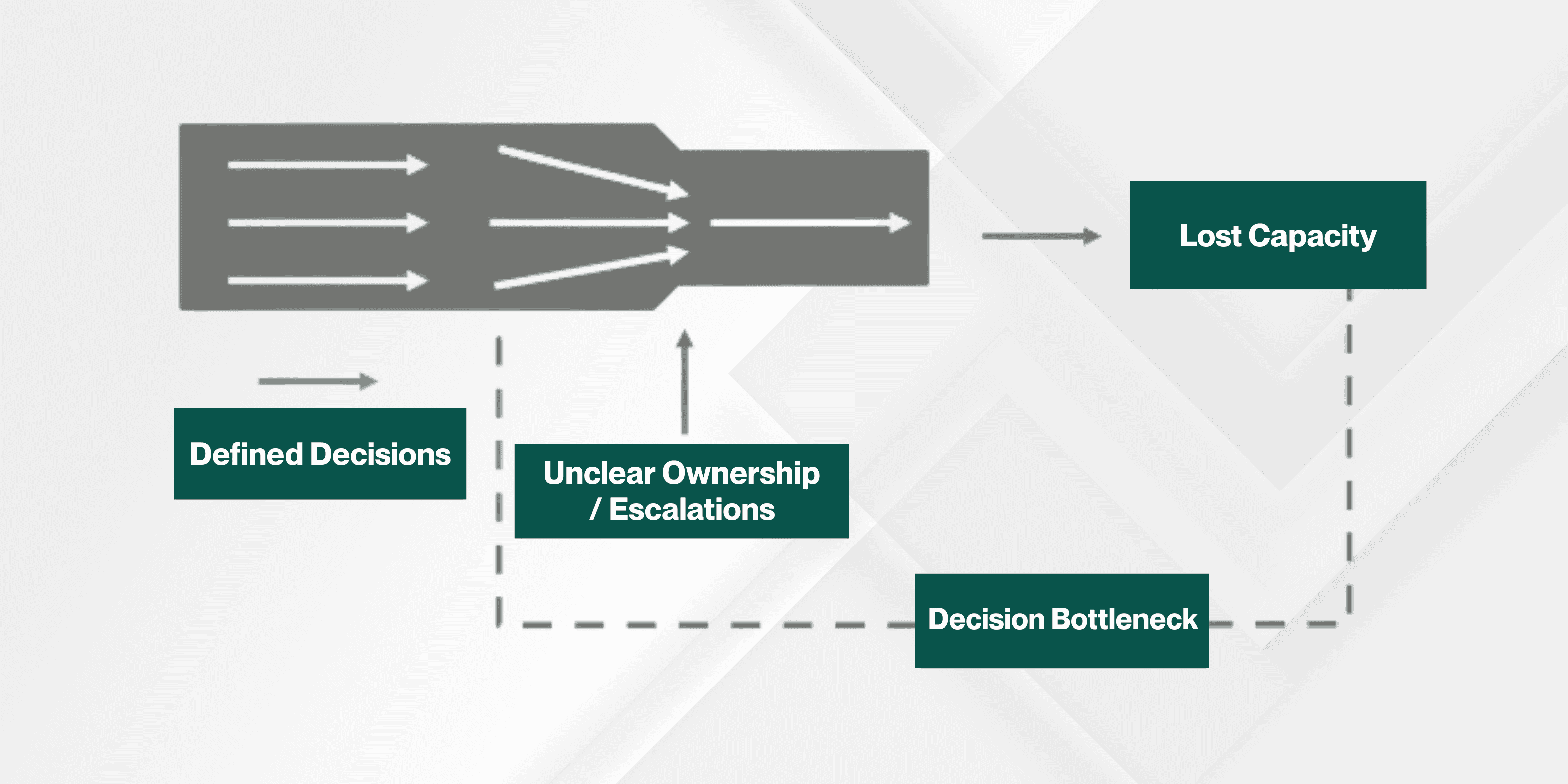
Growth rarely fails where most organizations expect it to.
When MSPs begin thinking about scalability, the focus usually turns toward visible constraints: staffing capacity, tooling, or service delivery efficiency. These are tangible, measurable, and relatively straightforward to address.
But many organizations encounter a different kind of limitation long before those factors reach their limits. It isn’t a shortage of resources or a lack of demand. It’s the way decisions move through the business.
In many MSPs, too many operational decisions flow through a single person. Sometimes it’s the owner. Sometimes it’s a senior engineer. Other times it’s a service manager who has become the unofficial authority on how things should be handled.
At first, centralized decision-making creates consistency. Leaders stay close to operations, and the team benefits from their experience. But as the organization grows, the volume of decisions increases alongside the volume of work.
At a certain point, growth starts being constrained by decision flow.
The organizations that move past this point don’t just hire more people. They change how decisions are made.
This shift is often what separates MSPs that plateau from those that continue to grow. As noted in Scalable MSP’s 2025 guide on sustainable growth, organizations that have “tried everything” often find that the issue isn’t effort or tooling, but a lack of operational structure that allows teams to execute consistently without constant oversight.
Addressing this requires a different way of looking at how decisions move through the organization.
At scale, even small decision delays compound. A one-minute pause on a ticket doesn’t register in isolation. Across hundreds or thousands of tickets, it quietly becomes dozens of hours of lost capacity each month.
What We’ll Explore
How decision bottlenecks form as MSP operations scale
Where decision-making slows service delivery and impacts efficiency
How IT decision frameworks create structure and reduce dependency
How to define escalation paths, approval thresholds, and decision rights
How standardization and automation reduce real-time decision load
How distributed decision-making improves scalability and resilience
Treat Decisions Like Part of the System
Most MSPs document technical processes. Fewer document how decisions should be made inside those processes.
That gap is where dependency forms. When a technician pauses to ask, “What should I do here?”, they are not lacking skill. They are encountering a moment the system hasn’t defined.
Scalable teams reduce these moments by designing decision logic into everyday workflows. This doesn’t require complex tooling. It requires identifying where decisions slow work down and replacing them with clear, repeatable rules.
For instance, instead of relying on leadership judgment for escalation, define what escalation actually means in your environment.
A simple structure is to establish a small set of escalation triggers that apply across most tickets:
the issue has recurred more than once for the same client
resolution is likely to exceed a defined time threshold
the ticket involves a system categorized as business-critical
When those conditions are met, escalation is automatic. The technician doesn’t need to decide. The system already has.
This small shift removes dozens of micro-decisions from the day and keeps work moving without interruption.
If a technician has to stop and ask what to do, the system is incomplete. Fix the system, not the technician.
Define What Doesn’t Need Approval
Approval is one of the most common sources of delay in MSP operations. Not because approvals are inherently slow, but because the boundary between what requires approval and what doesn’t is often unclear.
Technicians escalate decisions “just in case.” Managers review actions that could have been handled earlier. Work pauses while someone confirms what is acceptable.
Instead of tightening control, scalable teams define clear approval thresholds and decision rights.
A practical way to structure this is to group actions into three categories:
actions technicians can take independently
actions that require notification after the fact
actions that require approval before proceeding
A password reset or standard software reinstall may fall into the first category. A configuration change might require notification. A security policy change might require approval.
In more mature operating environments, this concept is formalized through defined decision rights. Frameworks like RACI (Responsible, Accountable, Consulted, Informed) clarify who is empowered to act and where accountability sits. While often used in project governance, the principle applies directly to IT service operations: when decision ownership is clearly defined, work moves without hesitation.
The exact categories will vary, but the principle remains the same: reduce ambiguity.
When technicians know where those boundaries are, they move faster and escalate less.
If everything feels like it needs approval, your system is unclear, not your team.
Standardize the First Response, Not Just the Fix
A large portion of decision friction doesn’t happen during resolution. It happens in communication.
Technicians spend time deciding how to respond to clients, especially in situations that are unclear or potentially sensitive. Even small delays in response can create the perception that work is not progressing.
One way to reduce this friction is to standardize initial responses for common scenarios. This doesn’t mean scripting every interaction. It means defining a consistent starting point.
That starting point should include:
acknowledgment within a defined timeframe
a clear statement of what is being investigated
a simple expectation for next steps
With these elements in place, technicians no longer need to decide how to begin each interaction. They can focus on resolving the issue itself.
Over time, this reduces response variability and removes another layer of hesitation from daily operations.
Speed isn’t just about resolution time. It’s about how quickly work appears to be moving to the client.
Move Repeated Decisions Into Automation
Some decisions happen so frequently that they no longer need to be made at all. These are the easiest opportunities to remove decision dependency entirely.
Start by reviewing a sample of recent tickets and identifying patterns:
tickets consistently assigned to the same technician or team
issues repeatedly marked as high priority
alerts that trigger the same sequence of actions
Once these patterns are visible, they can often be translated into simple automation rules within your PSA or RMM.
Tickets can be routed automatically based on issue type. Alerts tied to critical systems can be prioritized without manual review. Recurring requests can trigger predefined workflows.
Each automated rule eliminates a decision that would otherwise require attention.
Individually, these changes are small. Collectively, they reduce the number of decisions the team needs to make in real time.
The fastest way to operationalize this is to quantify the impact before you automate.
Take a 2-week sample of tickets and isolate:
the top 3 most repeated issue types
the top 2 technicians those tickets route to
the average handling time per ticket
If one issue type appears 40–60 times per week at 8–10 minutes per ticket, that’s 5–10 hours of decision-making and routing alone that can be eliminated with a single rule.
If you’re not automating your top 3 ticket types, you’re choosing to re-decide the same problem every day.
From there, implement lightweight automation:
Auto-route by keyword or category (not technician preference)
Auto-prioritize based on system tags (e.g. “business-critical”)
Trigger pre-built workflows for repeat requests (password resets, access issues, device setup)
The goal isn’t full automation. It’s decision reduction.
High-performing MSPs don’t automate everything. They automate the top 20% of scenarios that create 60–70% of repetitive decisions.
That’s where the immediate gain is.
Start with volume, not complexity. The highest-frequency work is where automation pays off fastest.
What High-Performing MSPs Do Differently
One of the clearest differences between MSPs that scale smoothly and those that plateau is how they handle decision-making at the service desk level.
In less structured environments, technicians are expected to interpret situations in real time. This works when teams are small and experienced, but it becomes inconsistent as new hires are added and ticket volume increases.
In more mature organizations, decision-making is embedded into the system itself.
Escalation is based on defined conditions, not instinct.
Client communication follows consistent patterns.
Approval requirements are visible and predictable.
When every technician approaches the same situation differently, the organization absorbs that variability through delays, rework, and internal questions. When the approach is standardized, those inconsistencies disappear.
Over time, this consistency compounds.
New technicians ramp faster
Managers spend less time reviewing decisions.
Clients experience more predictable service.
None of these improvements come from working harder. They come from reducing the number of decisions that need to be made in the first place.
Shift Leadership From Decision-Maker to System Designer
As decision frameworks take shape, the role of leadership changes. Instead of being the point where decisions are made, leaders become responsible for how decisions are structured.
On a weekly or biweekly basis, review a small sample of tickets and ask:
Where did work pause while waiting for input?
Which decisions were escalated unnecessarily?
What questions came up more than once?
Each of these moments points to a gap in the system.
Instead of solving them individually, convert them into reusable rules and guidelines.
If the same question comes up twice, it’s no longer a question. It’s a missing rule.
Why This Matters More Than It Seems
Many MSPs continue to grow while operating with high decision dependency. On the surface, everything appears functional.
But behind that activity, a different pattern emerges. The numbers tell the real story of how invisible friction compounds.
In most MSP environments, even a 1–2 minute delay per ticket caused by uncertainty or escalation adds up quickly. Across 1,000+ monthly tickets, that becomes 15–30 hours of lost operational time.
That’s nearly a full work week lost to hesitation, not complexity.
The system works, but only because certain individuals are continuously filling in the gaps.
In our previous article, When “We’re Fine” Isn’t Fine: The IT Leader’s Escape Plan, this kind of hidden constraint is described as a system that appears stable but relies heavily on unseen effort to maintain it.
Building Decision Capacity Into the Organization
Scalability isn’t just about handling more work. It’s about handling more decision flow without slowing down.
Organizations that achieve this don’t eliminate decision-making. They distribute it. They build frameworks where common scenarios are defined, technicians understand their authority, and routine decisions no longer require escalation.
The goal is not to remove leaders from operations entirely. Leadership insight remains essential, especially in unfamiliar or high-impact situations.
Instead, the objective is to ensure that leadership attention is focused where it provides the most value.
When routine decisions are distributed effectively, organizations move faster, operate more consistently, and become more resilient.
This is how teams scale without adding headcount, by removing friction, not adding people.
A Practical Starting Point
If there’s one place to begin, it’s this:
Pick a single workflow; ticket escalation, client communication, or approvals, and identify the decisions that occur most often within it.
Then define just a few rules that remove ambiguity from those moments.
You don’t need a complete framework to see progress. You need a system that reduces one category of decisions today.
Pick one workflow. Remove 5 decisions. Measure the time saved. Repeat.
From there, the pattern becomes easier to repeat.
Over time, the bottleneck that once limited growth becomes part of the system that enables it.
For teams looking to operationalize this approach, the first step is visibility. Understanding where decisions slow work down makes it possible to design systems that remove that friction.
Platforms like Helpt reduce decision load at the source by handling repeat frontline requests with a consistent, structured approach, so internal teams aren’t pulled into the same decisions over and over.
About the Author

Editor, Author, Designer & Podcast Visual Producer
Michelle Burnham is a freelance editor, book formatter, and cover designer who helps authors and brands bring ideas to life with clarity, consistency, and visual impact. Her work blends editorial precision with creative design, ensuring every project feels cohesive across words and visuals. In addition to her freelance practice, she serves as a contract graphic designer and visual producer for Helpt and is also a published author writing under a pseudonym.
Based in California.
Agents Nationwide.
©2026 Helpt, a part of PAG Technology Inc. All Rights Reserved.