When Escalation Becomes the System
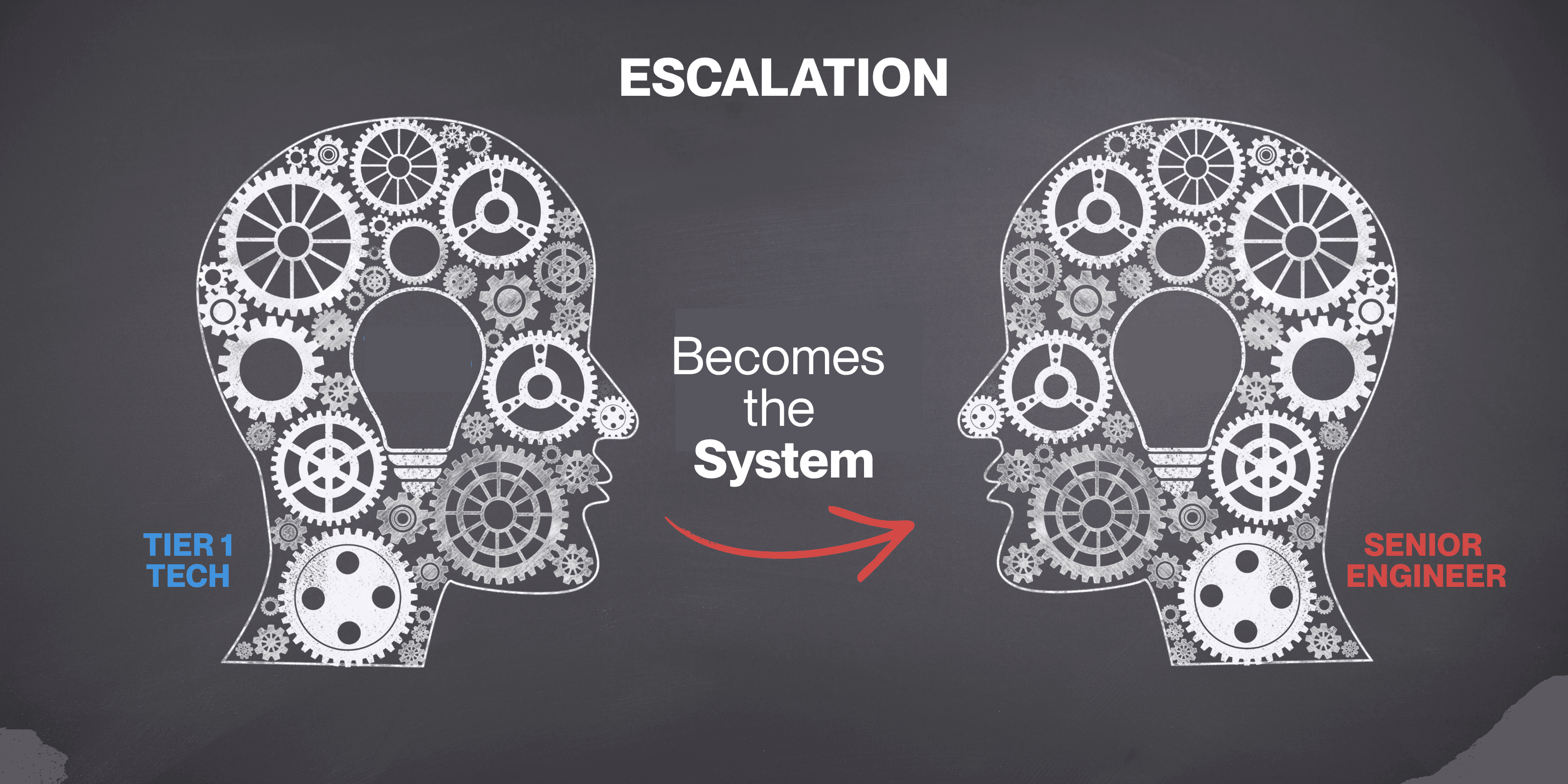
Growth in MSPs rarely causes immediate structural failure; it mainly increases strain, while accelerating IT team burnout. And it doesn’t distribute evenly across the team but falls on a small group of people who consistently solve the hardest problems.
Your senior engineers.
They become the escalation point. The safety net. The ones who everyone turns to when something isn’t clear, or fast enough, or just isn’t working. And they keep up with this for a time, but eventually, something shifts.
The same senior engineers who make your service delivery stronger also become the constraint that limits how far it can scale. But this isn’t just a workload problem, it’s structural.
In this article, we’ll explore:
why escalation-heavy systems quietly burn out your most experienced engineers
how to reduce dependency on senior talent without reducing impact
what it takes to distribute expertise across your team effectively
how to scale capacity without adding headcount or increasing strain
Why Escalation Dependency Doesn’t Scale
Escalation is necessary. But there’s a fine balance.
When upward routing becomes the default path for moving work forward, it stops being a safeguard and starts acting as a bottleneck generator. Not because senior engineers can’t handle the volume, but because the workflow is using them to compensate for gaps upstream.
Every escalation introduces delay. Not just in the moment, but in how work flows overall. Even when the fix is simple, the path to resolution becomes longer than it needs to be.
But the bigger issue is distribution.
When teams rely heavily on service desk escalation, complexity doesn’t get handled at the right level, it gets deferred upward. Over time, that changes how the entire team operates. Mid-level technicians hesitate to make decisions. Junior staff escalate earlier than necessary. And senior engineers become the default checkpoint for work that should already be in motion.
That’s not scale. It’s concentration.
According to Resolution, mature service desks typically aim for a 15%-25% escalation rate, while first-level resolution benchmarks suggest roughly one-third of issues still need additional handling.
The shift isn’t about reducing escalations outright, but about ensuring that when it happens, it’s adding value, not compensating for missing structure.
The Hidden Cost of Relying on Your Best People
High performers attract work, not just because they’re capable, but because they’re trusted.
When a ticket is unclear, it gets escalated. When a technician isn’t confident, they ask for help. When something is urgent, it gets routed to the person most likely to solve it quickly.
Individually, these decisions make sense. Collectively, they create concentration.
Over time, senior engineers are no longer just solving complex problems, they’re reviewing work, filling gaps, validating decisions, and stepping in whenever the system breaks down.
That shift has measurable consequences.
First, it reduces the quality of their output. Complex problem-solving requires sustained focus. When that focus is fragmented, even experienced engineers spend more time reorienting than progressing the work.
Second, it increases cognitive load. Switching between unrelated issues, rebuilding context, and responding to constant interruptions creates a level of mental overhead that compounds over time.
This is where IT team burnout starts to take shape. Not from volume alone, but from fragmentation.
According to a Dice survey conducted in early 2026, 46% of tech professionals report experiencing burnout, a significant increase from 31% in 2024. And according to Eagle Hill Consulting, employees experiencing burnout are nearly three times more likely to leave their roles.
In MSP environments, that risk concentrates around senior engineers because they carry a disproportionate share of reactive work.
The impact isn’t just individual.
As senior capacity erodes, resolution slows, escalation increases, and more pressure is placed on the same limited group of people. Over time, that creates a feedback loop where the environment becomes increasingly dependent on the very individuals it’s wearing down.
That’s the hidden cost. Not just that senior engineers are busy, but that their time is being consumed by work that doesn’t require their level of expertise, while the work that does is forced to compete for attention.
How to Distribute Expertise Across the Team
If the goal is to scale without burning out senior engineers, the solution is to change how expertise is applied.
Right now, in many MSP environments, expertise is reactive. Senior engineers get pulled into problems after they’ve already been created.
To scale effectively, that needs to shift upstream. There are three structural ways to do that.
First, improve how work is shaped before it reaches the team.
When tickets arrive with incomplete context, unclear scope, or incorrect routing, they’re far more likely to require senior intervention. Strengthening intake reduces the number of tickets that need senior intervention in the first place.
This is where many teams see the fastest gains.
Second, make expertise reusable.
When senior engineers solve complex issues, that knowledge often stays with them. Unless it’s captured and structured, the same types of problems continue to require the same level of intervention.
Building lightweight documentation processes, standardizing resolutions for recurring issues, and creating accessible knowledge pathways allows the rest of the team to handle more work independently and effectively.
Third, clarify escalation boundaries.
Many escalations happen not because they’re necessary, but because the path forward isn’t clear.
Defining what should be escalated, when, and with what level of context reduces unnecessary handoffs. It also builds confidence across the team, because technicians understand where their responsibility ends and where senior support begins.
None of these changes eliminate the need for senior engineers. But they ensure their time is spent where it creates the most impact.
Protecting Senior Capacity While Increasing Output
The goal is to protect the capacity of your senior talent for the work that actually requires them. That requires a shift in how their role is defined.
Instead of being the default escalation point, they become a leveraged resource. That means fewer reactive interruptions and more structured involvement.
For example, instead of answering ad hoc questions throughout the day, senior engineers can operate within defined escalation windows or structured review cycles. Instead of being pulled into partially formed tickets, they engage with work that has already been shaped and scoped appropriately.
This changes the nature of their workload. From fragmented to focused. From reactive to intentional.
And it has a measurable impact.
McKinsey found that 70% of employees surveyed define their individual purpose through their work, highlighting the importance of organizational role clarity and purpose in attracting and keeping staff.
In an MSP environment, that gain doesn’t come from working faster. It comes from reducing the friction that prevents skilled people from doing their best work.
This isn’t just about efficiency. It’s what prevents burnout from compounding. When senior engineers can stay focused on high-value work, cognitive load drops, interruptions decrease, and the role becomes sustainable again.
Scaling Expertise Without Adding Headcount
Most MSPs assume that growth requires adding more senior talent. But senior engineers are the hardest roles to hire, and the slowest to ramp.
So the more practical question becomes: How do you extend the impact of the senior talent you already have?
The answer isn’t just reducing escalations. It’s redesigning the operating model those escalations are coming from.
In What Your Best Engineers Shouldn’t Be Doing, we explored how much senior time gets consumed by work that doesn’t require their level of expertise. This is the other side of that equation.
It’s not just about removing the wrong work. It’s about ensuring the right work reaches them at the right time, in the right condition.
That only happens when three things are true:
Work is shaped before it moves. Tickets arrive with enough clarity and structure that they can be handled at the appropriate level without immediate senior involvement.
Expertise is embedded, not just accessed. Knowledge isn’t locked in individuals. It’s captured, reused, and built into how the team operates.
Escalation is intentional. Senior engineers are engaged when their input adds value, not when the system runs out of options.
When those conditions are in place, something shifts. Senior engineers stop acting as a constant point of intervention and start operating as a point of leverage.
A Structure That Scales People, Not Just Work
Burnout isn’t just a people problem. It’s a network signal. It shows you where work is being misrouted, where context is missing, and where too much responsibility is concentrated in too few hands.
Fixing it doesn’t mean asking senior engineers to do less. It means designing a system where they don’t have to compensate for gaps elsewhere.
This is where many MSPs start to rethink how work enters and moves through their service desk.
Because if intake is inconsistent, escalation will always carry more weight than it should. If tickets aren’t shaped early, senior engineers will continue to reconstruct them later. And if that pattern holds, no amount of hiring will fully relieve the pressure.
The teams that solve this don’t just redistribute work, they stabilize it.
In some cases, that means building stronger internal triage layers. In others, it means extending that function with a partner that operates as an embedded part of the service desk, ensuring work is structured, complete, and ready before it reaches the team.
That kind of consistency changes everything downstream.
Fewer tickets require escalation. When they do, they arrive with context. Senior engineers stay focused longer. And the rest of the team becomes more capable because they’re not constantly blocked or second-guessing decisions.
That’s how capacity expands without adding headcount. Not by pushing people harder, or layering on more automation, but by reducing the amount of unnecessary work your most experienced people have to absorb.
Because when your structure supports the team, rather than relying on it to compensate, growth stops feeling like strain. And your best engineers stop being the safety net for a system that should be supporting them.
If you’re rethinking how work enters and moves through your service desk, that’s exactly where Helpt is built to support.
About the Author

Editor, Author, Designer & Podcast Visual Producer
Michelle Burnham is a freelance editor, book formatter, and cover designer who helps authors and brands bring ideas to life with clarity, consistency, and visual impact. Her work blends editorial precision with creative design, ensuring every project feels cohesive across words and visuals. In addition to her freelance practice, she serves as a contract graphic designer and visual producer for Helpt and is also a published author writing under a pseudonym.
Based in California.
Agents Nationwide.
©2026 Helpt, a part of PAG Technology Inc. All Rights Reserved.