What You Do Matters. When You Do It Matters More.
Why good IT initiatives fail, and what has to come first
Why small IT teams keep launching the right initiatives at the wrong time and how fixing the sequence changes everything about after-hours support.
IN THIS ARTICLE
Why good IT initiatives fail even when the solution is right
The four operational maturity traps small IT teams fall into
How sequencing impacts after-hours incident response
A 5-question diagnostic to find your missing foundation
THE PATTERN
You've seen this story before. Maybe you've lived it.
January | The team decides documentation needs to improve. |  |
February | A shared knowledge base is launched. | |
March | The knowledge base is already out of date. | |
April | Leadership asks for better monitoring. | |
May | New alerts are configured. | |
June | Technicians are overwhelmed with notifications that don't help them prioritize anything. | |
July | An after-hours incident exposes the gaps in ownership and escalation that nobody documented. |
None of those initiatives were bad ideas. They're actually exactly what mature IT organizations do well. But they failed. Not because the solutions were wrong, but because the team wasn't ready for them yet.
Tim Fitzpatrick, President of Rialto Marketing and recent guest on the Cool Kids Table Podcast, put it simply:
"What you do is important, but when you do it is even more important."
A strategy can be completely sound and still fail if the organization isn't ready for it. The sequencing was wrong. This isn't a revelation in business strategy, but most IT leaders still aren't applying it to their own operations. They're asking "what do we improve next?" when the more important question is: what has to be true before this can succeed?
WHY THIS HITS HARDER AFTER HOURS
The Sequencing Problem Gets Dangerous at 2 AM
On a Tuesday afternoon, launching the wrong initiative in the wrong order costs time and morale. After hours, it costs more than that.
Remote employees span time zones. Critical systems don't clock out. Business leaders want incident updates before 6 AM. When you expand after-hours coverage before your team has the visibility, ownership, and documentation to act on it, the gaps in your operational foundation don't just slow you down. They compound.
40% of organizations report more than a quarter of their on-call engineers showing burnout symptoms from incident management | $50K+ per hour: what 61% of organizations estimate infrastructure downtime costs, with 34% putting it at $100K or more | 30% of engineers’ weeks is now spent on operational work, up from 25% the year prior, and most incident tools don’t capture the human cost |
For a small IT team of two to ten technicians, a single after-hours incident handled without proper visibility, clear ownership, or documented escalation paths can consume an entire day of recovery time and push your best people closer to the door.
THE ROOT ISSUE
It's Not a Lack of Ideas. It's Operational Readiness.
Most IT leaders can recite their pain points without hesitation: better documentation, clearer processes, healthier after-hours coverage, stronger incident response. The problem isn't identifying what needs attention. The problem is determining what needs to happen first.
When improvements are implemented out of sequence, teams experience the exact opposite of the intended result. Documentation becomes outdated. Monitoring creates noise. Projects stall. Technicians burn out.
Operational maturity isn't built by doing more things. It's built by doing the right things in the right order.
FOUR OPERATIONAL MATURITY TRAPS
Where Sequence Breaks Down
Where Sequence Breaks Down
Trap 1: Documenting Before Creating Capacity
Documentation is the most common goal on any IT roadmap, and for good reason. Better documentation reduces escalations, improves consistency, and speeds up onboarding.
Most documentation initiatives fail the same way: nobody has time to maintain them. When technicians spend every day in the ticket queue, documentation becomes something that gets updated "when there's time." That time rarely arrives. The initiative starts strong and slowly dies.
The issue isn't a lack of knowledge. It's a lack of protected capacity. Before launching a documentation overhaul, identify dedicated time for operational improvement work, time that's shielded from the daily interrupt queue. Without that, you're asking documentation to compete with urgency. Urgency wins every time.
Quick Check
When was the last time a technician had protected, scheduled time to work on documentation? Not "fit it in" but actually blocked for it. If the answer is never or not recently, capacity is the real bottleneck.
Trap 2: Expanding Monitoring Before Defining Ownership
When visibility is limited, more monitoring feels like the obvious fix. More alerts should mean fewer surprises. In practice, many teams end up with more notifications, more interruptions, and more uncertainty about what actually requires attention.
Visibility without ownership creates noise. When an alert fires, your on-call technician needs immediate answers: Who owns this system? How critical is it? What happens if no one acts? Who else needs to know?
Without that context already documented, every alert becomes an investigation. After hours, a sleep-interrupted technician is triaging in the dark, without ownership records and without a clear escalation path.
Quick Check
Pick three recent alerts. Could every technician on your team identify the system owner and the correct escalation path in under 60 seconds? If not, ownership is the work that needs to happen before you expand monitoring.
Trap 3: Improving Response Before Improving Triage
Resolution speed is a natural focus. How fast are tickets closed? How quickly are incidents resolved? These metrics matter, but for most small teams, response speed isn't the real constraint.
The bigger issue is usually how work reaches the team in the first place. When intake is inconsistent, frontline technicians receive work they shouldn't handle, senior technicians become the bottleneck for everything, and urgent issues compete with routine requests in the same queue.
Everyone stays busy. Progress still feels slow. That's not a staffing problem. It's a triage problem. When work is properly categorized, prioritized, and routed, resolution often improves without any change to team size or tooling.
Quick Check
Review your last 50 tickets. How many required reassignment after initial intake? A high reassignment rate typically signals a triage problem, not a capacity problem.
Trap 4: Expanding Coverage Before Building Visibility
This is the trap that catches the most well-intentioned teams.
After-hours support has become a real expectation. Remote employees work across time zones. Critical infrastructure doesn't take weekends. Business leaders want to know someone is watching. So teams respond by adding on-call rotations and expanding after-hours responsibilities.
Coverage alone doesn't solve the problem. If a technician gets paged at midnight without access to business impact data, incident history, ownership information, and response documentation, the coverage is theater. They'll spend the first 45 minutes reconstructing context that should have been available in 90 seconds.
The same gaps that slow response during business hours become exponentially more costly after hours. Visibility is the prerequisite that makes coverage actually work.
Quick Check
If a critical alert fired tonight, could your on-call technician answer these four questions within five minutes: what broke, who is affected, who owns it, and has it happened before? If not, visibility is the more urgent investment.
THE CORRECT ORDER
What Has to Come First
Mature IT teams don't necessarily have larger budgets or larger staffs. What they have is a better understanding of sequence. Instead of asking "what should we improve next?" they ask "what has to be true before this succeeds?"
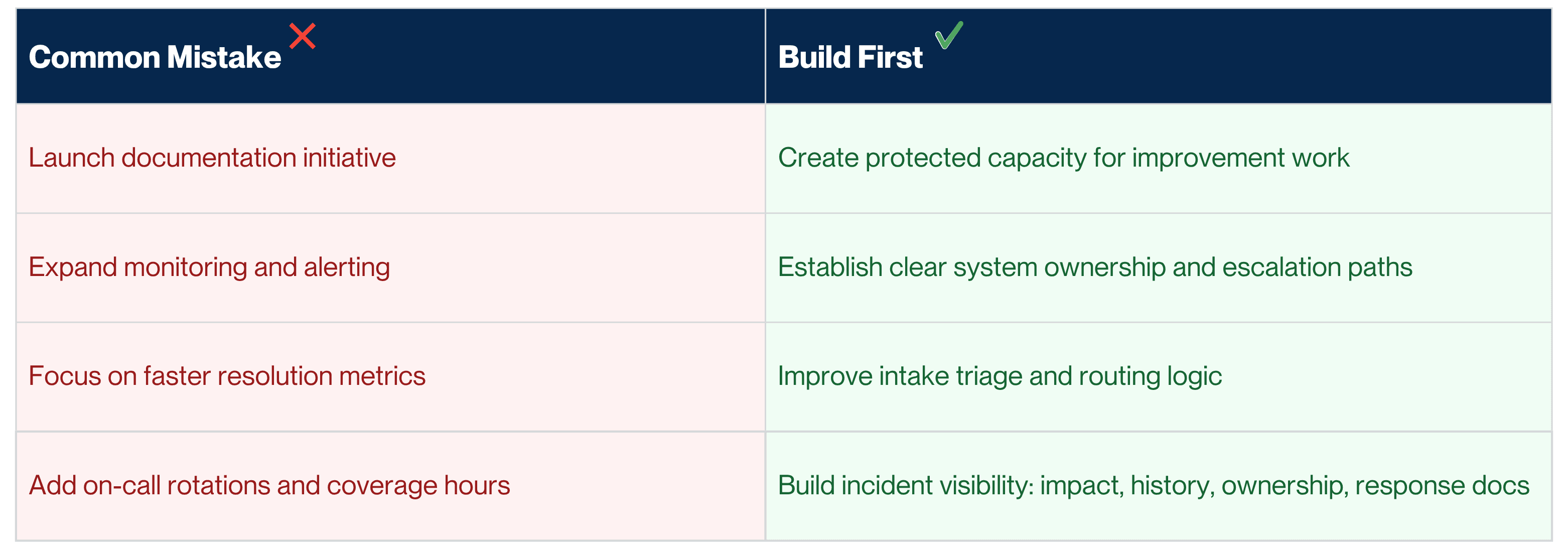
That shift in thinking prevents teams from building solutions on unstable foundations. And over time, those foundations make every future improvement faster, cheaper, and more durable.
Is Your Team Ready for What's Next?
Before your next IT initiative, answer these five questions honestly.
If you answer "no" to any of them, that gap, not the initiative itself, is where your team's energy should go first.
|
|
|
|
|
The teams that consistently improve operations don't do more than everyone else. They just build the foundation first.
The Goal Isn't More Initiatives. It's Better Sequence.
Most small IT teams aren't short on ideas. They know where the pain is. What determines success isn't the initiative itself. It's whether the organization was ready for it.
Strategy without sequence is just a wishlist. The teams that get it right start by asking a different question: not what's next, but what has to come first.
About the Author

Michelle Burnham has worked in and around the technology industry for nearly a decade; collaborating with IT support teams and contributing to technical documentation, service-oriented content, and operational communications. With a background in editing, formatting, and visual design, she specializes in translating complex ideas into clear, engaging content. In addition to her freelance creative work, she serves as a contract graphic designer, copywriter, and video editor for Helpt.
Why good IT initiatives fail, and what has to come first
Why small IT teams keep launching the right initiatives at the wrong time and how fixing the sequence changes everything about after-hours support.
IN THIS ARTICLE
Why good IT initiatives fail even when the solution is right
The four operational maturity traps small IT teams fall into
How sequencing impacts after-hours incident response
A 5-question diagnostic to find your missing foundation
THE PATTERN
You've seen this story before. Maybe you've lived it.
January | The team decides documentation needs to improve. | |
February | A shared knowledge base is launched. | |
March | The knowledge base is already out of date. | |
April | Leadership asks for better monitoring. | |
May | New alerts are configured. | |
June | Technicians are overwhelmed with notifications that don't help them prioritize anything. | |
July | An after-hours incident exposes the gaps in ownership and escalation that nobody documented. |
None of those initiatives were bad ideas. They're actually exactly what mature IT organizations do well. But they failed. Not because the solutions were wrong, but because the team wasn't ready for them yet.
Tim Fitzpatrick, President of Rialto Marketing and recent guest on the Cool Kids Table Podcast, put it simply:
"What you do is important, but when you do it is even more important."
A strategy can be completely sound and still fail if the organization isn't ready for it. The sequencing was wrong. This isn't a revelation in business strategy, but most IT leaders still aren't applying it to their own operations. They're asking "what do we improve next?" when the more important question is: what has to be true before this can succeed?
WHY THIS HITS HARDER AFTER HOURS
The Sequencing Problem Gets Dangerous at 2 AM
On a Tuesday afternoon, launching the wrong initiative in the wrong order costs time and morale. After hours, it costs more than that.
Remote employees span time zones. Critical systems don't clock out. Business leaders want incident updates before 6 AM. When you expand after-hours coverage before your team has the visibility, ownership, and documentation to act on it, the gaps in your operational foundation don't just slow you down. They compound.
40% of organizations report more than a quarter of their on-call engineers showing burnout symptoms from incident management | $50K+ per hour: what 61% of organizations estimate infrastructure downtime costs, with 34% putting it at $100K or more | 30% of engineers’ weeks is now spent on operational work, up from 25% the year prior, and most incident tools don’t capture the human cost |
For a small IT team of two to ten technicians, a single after-hours incident handled without proper visibility, clear ownership, or documented escalation paths can consume an entire day of recovery time and push your best people closer to the door.
THE ROOT ISSUE
It's Not a Lack of Ideas. It's Operational Readiness.
Most IT leaders can recite their pain points without hesitation: better documentation, clearer processes, healthier after-hours coverage, stronger incident response. The problem isn't identifying what needs attention. The problem is determining what needs to happen first.
When improvements are implemented out of sequence, teams experience the exact opposite of the intended result. Documentation becomes outdated. Monitoring creates noise. Projects stall. Technicians burn out.
Operational maturity isn't built by doing more things. It's built by doing the right things in the right order.
FOUR OPERATIONAL MATURITY TRAPS
Where Sequence Breaks Down
Where Sequence Breaks Down
Trap 1: Documenting Before Creating Capacity
Documentation is the most common goal on any IT roadmap, and for good reason. Better documentation reduces escalations, improves consistency, and speeds up onboarding.
Most documentation initiatives fail the same way: nobody has time to maintain them. When technicians spend every day in the ticket queue, documentation becomes something that gets updated "when there's time." That time rarely arrives. The initiative starts strong and slowly dies.
The issue isn't a lack of knowledge. It's a lack of protected capacity. Before launching a documentation overhaul, identify dedicated time for operational improvement work, time that's shielded from the daily interrupt queue. Without that, you're asking documentation to compete with urgency. Urgency wins every time.
Quick Check
When was the last time a technician had protected, scheduled time to work on documentation? Not "fit it in" but actually blocked for it. If the answer is never or not recently, capacity is the real bottleneck.
Trap 2: Expanding Monitoring Before Defining Ownership
When visibility is limited, more monitoring feels like the obvious fix. More alerts should mean fewer surprises. In practice, many teams end up with more notifications, more interruptions, and more uncertainty about what actually requires attention.
Visibility without ownership creates noise. When an alert fires, your on-call technician needs immediate answers: Who owns this system? How critical is it? What happens if no one acts? Who else needs to know?
Without that context already documented, every alert becomes an investigation. After hours, a sleep-interrupted technician is triaging in the dark, without ownership records and without a clear escalation path.
Quick Check
Pick three recent alerts. Could every technician on your team identify the system owner and the correct escalation path in under 60 seconds? If not, ownership is the work that needs to happen before you expand monitoring.
Trap 3: Improving Response Before Improving Triage
Resolution speed is a natural focus. How fast are tickets closed? How quickly are incidents resolved? These metrics matter, but for most small teams, response speed isn't the real constraint.
The bigger issue is usually how work reaches the team in the first place. When intake is inconsistent, frontline technicians receive work they shouldn't handle, senior technicians become the bottleneck for everything, and urgent issues compete with routine requests in the same queue.
Everyone stays busy. Progress still feels slow. That's not a staffing problem. It's a triage problem. When work is properly categorized, prioritized, and routed, resolution often improves without any change to team size or tooling.
Quick Check
Review your last 50 tickets. How many required reassignment after initial intake? A high reassignment rate typically signals a triage problem, not a capacity problem.
Trap 4: Expanding Coverage Before Building Visibility
This is the trap that catches the most well-intentioned teams.
After-hours support has become a real expectation. Remote employees work across time zones. Critical infrastructure doesn't take weekends. Business leaders want to know someone is watching. So teams respond by adding on-call rotations and expanding after-hours responsibilities.
Coverage alone doesn't solve the problem. If a technician gets paged at midnight without access to business impact data, incident history, ownership information, and response documentation, the coverage is theater. They'll spend the first 45 minutes reconstructing context that should have been available in 90 seconds.
The same gaps that slow response during business hours become exponentially more costly after hours. Visibility is the prerequisite that makes coverage actually work.
Quick Check
If a critical alert fired tonight, could your on-call technician answer these four questions within five minutes: what broke, who is affected, who owns it, and has it happened before? If not, visibility is the more urgent investment.
THE CORRECT ORDER
What Has to Come First
Mature IT teams don't necessarily have larger budgets or larger staffs. What they have is a better understanding of sequence. Instead of asking "what should we improve next?" they ask "what has to be true before this succeeds?"
That shift in thinking prevents teams from building solutions on unstable foundations. And over time, those foundations make every future improvement faster, cheaper, and more durable.
Is Your Team Ready for What's Next?
Before your next IT initiative, answer these five questions honestly.
If you answer "no" to any of them, that gap, not the initiative itself, is where your team's energy should go first.
|
|
|
|
|
The teams that consistently improve operations don't do more than everyone else. They just build the foundation first.
The Goal Isn't More Initiatives. It's Better Sequence.
Most small IT teams aren't short on ideas. They know where the pain is. What determines success isn't the initiative itself. It's whether the organization was ready for it.
Strategy without sequence is just a wishlist. The teams that get it right start by asking a different question: not what's next, but what has to come first.
About the Author
Michelle Burnham has worked in and around the technology industry for nearly a decade; collaborating with IT support teams and contributing to technical documentation, service-oriented content, and operational communications. With a background in editing, formatting, and visual design, she specializes in translating complex ideas into clear, engaging content. In addition to her freelance creative work, she serves as a contract graphic designer, copywriter, and video editor for Helpt.
Stop Answering Calls.
Start Driving Growth.
Let Helpt's US-based technicians handle your support calls 24x7 while your team focuses on what matters most.
Stop Answering Calls.
Start Driving Growth.
Let Helpt's US-based technicians handle your support calls 24x7 while your team focuses on what matters most.
Stop Answering Calls.
Start Driving Growth.
Let Helpt's US-based technicians handle your support calls 24x7 while your team focuses on what matters most.
©2026 Helpt, a part of PAG Technology Inc. All Rights Reserved.