Employees Have Stopped Submitting Tickets. They're Just Working Around You.

Shadow IT rarely starts as rebellion. It starts the moment an employee decides a ticket isn't worth the wait, and quietly solves the problem themselves.
IN THIS ARTICLE |
|
The Ticket That Never Got Submitted
Tessa needs to send a large file to a client. A year ago, her first move would have been opening a ticket. Not anymore.
She's learned that a ticket means a wait. Maybe hours, maybe days, maybe a follow-up question that sits untouched over a weekend while the deadline keeps moving closer.
So Tessa skips the ticket entirely. She signs up for a free file-sharing service, sends the file, and moves on with her afternoon. Problem solved, at least from her side of the desk.
From IT's side, a different problem just started. Company data is now sitting somewhere outside approved systems, and nobody logged a request or asked a single question first.
This is usually where conversations about Shadow IT begin: the unauthorized tool. But that's rarely where the problem actually starts.
It starts much earlier. It starts the moment an employee decides opening a ticket will take longer than solving the problem themselves.
By the time IT discovers the unapproved app, trust in the support process has already been lost.
Why Shadow IT Is a Trust Problem Before It's a Security Problem
When IT leaders discuss Shadow IT, the conversation usually centers on security, compliance, and unauthorized software. Those risks are real, but they're symptoms, not the cause.
The real issue is trust.
When employees stop believing a ticket will solve their problem quickly enough, they'll find another way. They're not trying to break policy. They're trying to keep work moving.
That isn't defiance. It's just what people do when a process stops working for them.
53% of employees say they purposefully avoid the help desk altogether Source: PeopleReign employee help desk survey (via ITSM.tools) | 67% of employees at Fortune 1000 companies use apps IT never explicitly approved Source: Insider Risk Index | 57% |
That first number is worth sitting with. More than half of employees in that survey go out of their way to avoid the help desk, not because the issue wasn't worth reporting, but because they didn't expect the interaction to be quick or useful.
In this week's Cool Kids Table Podcast episode, Support Fusion CEO Greg Rudakov described a pattern many growing organizations recognize. As companies scale, processes naturally get more complex: more approvals, more documentation, more steps added in the name of consistency. Those changes usually start out solving a real problem. The danger is when the process drifts away from its original purpose.
For IT teams, that purpose was never the ticket itself, the workflow, or the documentation. Those things matter, but they're not the mission. The mission is helping people work effectively and securely. When employees stop believing the ticket serves that purpose, Shadow IT fills the gap.
Find the Process That Created the Workaround
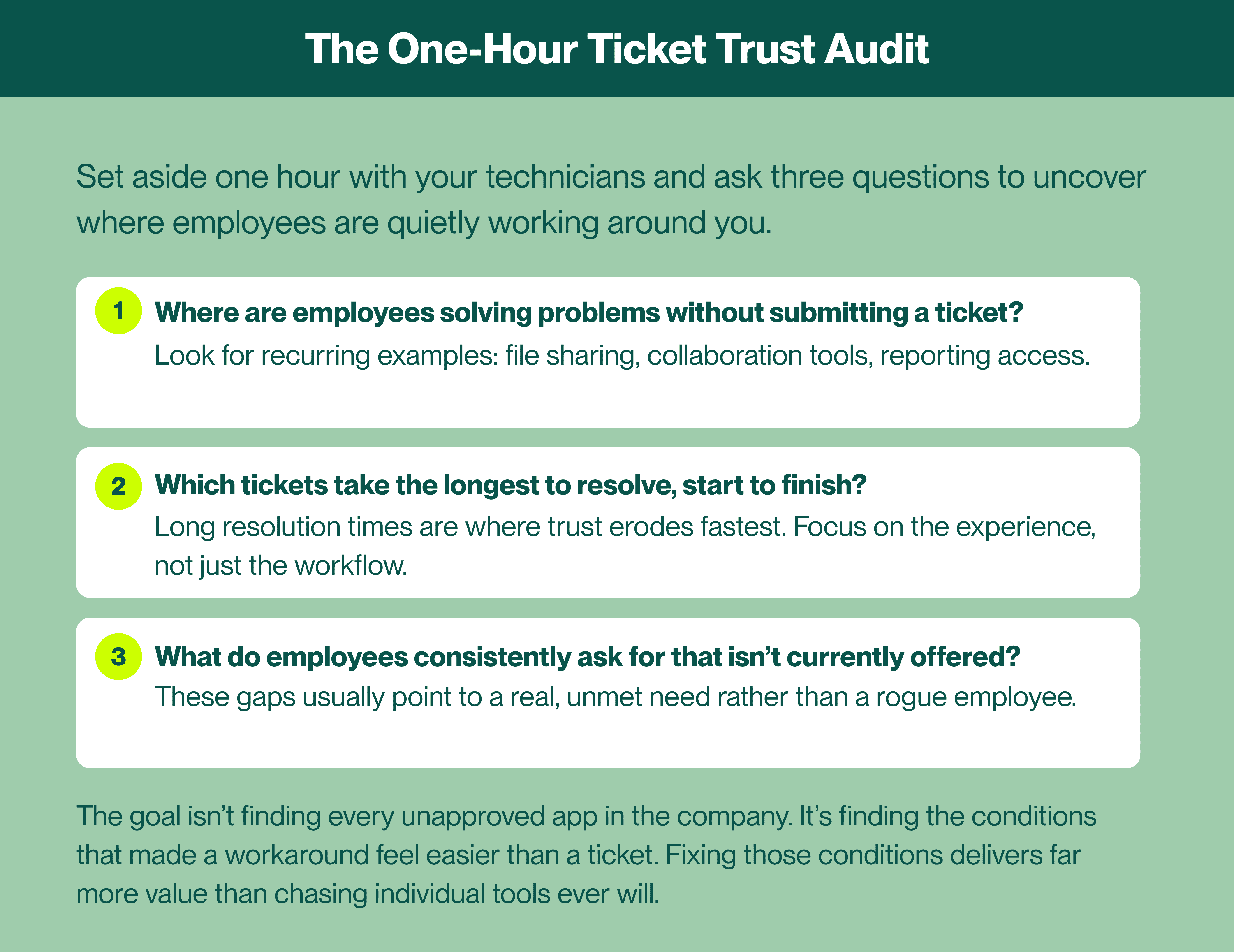
Most Shadow IT conversations start with the question, "What unauthorized tools are employees using?" It's usually the wrong first one. A better question is, "What problem was the employee trying to solve, and why didn't a ticket feel like the fastest way to solve it?"
Every workaround exists because a request process failed to meet a need in the moment it was needed. The employee uploading files to a personal cloud account is trying to share information quickly. The manager who buys a project tool without looping in IT is trying to keep a project moving.
The tool is usually just the symptom. The gap in the process is the cause.
ASK THIS | WHY IT MATTERS |
Which ticket types take the longest to resolve? | Long resolution times create demand for alternatives. |
What do employees follow up on most often? | Repeated follow-ups usually signal uncertainty about status. |
Which requests require the most handoffs? | Every handoff adds friction and another chance to stall. |
Where is your frontline team spending time on manual admin work? | Internal inefficiency often becomes an external frustration. |
Which tickets get abandoned before resolution? | Employees may already be solving it another way. |
Greg Rudakov put it plainly:
"It's amazing the amount of manual handling that's going on in businesses that hasn't been weeded out."
The same is often true of ticket processes. Employees don't build workarounds because they're chasing more complexity. They build them because they're chasing less.
When Good Process Creates Bad Outcomes
Shadow IT isn't always the result of people avoiding IT. Sometimes it's the result of a process that never removed enough friction from the employee's day.
Picture a routine software request. The employee submits a ticket. It sits in a queue, a few days pass, someone asks for more information, and another review gets scheduled. By the time approval comes through, the employee has already found a free alternative and moved on.
From IT's perspective, the process worked exactly as designed. From the employee's perspective, it never solved the problem. This is where a lot of organizations get stuck, tightening the process further while wondering why Shadow IT keeps growing anyway.
Greg made an observation that will sound familiar to most small IT teams:
"There are people employed in organizations whose entire job is copying and pasting updates from one system to another as a full-time job in 2026."
Shadow IT tends to show up wherever employees run into that kind of inefficiency every day. When a process requires multiple handoffs, repeated data entry, or waiting on an update that could have been automated, people go find a faster way. It isn't rebellion. The workaround simply feels more efficient than the official path, and often, it is.
Greg shared a philosophy worth keeping close as your process grows: "Keep your purpose close, keep your vision close, and you won't feel as much of the bureaucracy." As IT teams add structure to support more employees and more technology, the goal isn't to avoid processes. It's to make sure the process still serves the reason it exists.
Five Changes You Can Make This Month
Reducing Shadow IT doesn't require stricter policy or another security platform. Most of the time, it requires making the approved path faster than the workaround.
|
This week: find one approval step that only exists because "that's how we've always done it." |
|
This week: identify your top three recurring requests and document approved options for each. |
|
This week: pick a process that touches three or more people and simplify it. |
|
This week: have a non-technical employee read your request process back to you. If they can't explain it, simplify it. |
|
This week: add "recent workarounds" as a standing item on your next team meeting agenda. |
The Small Team Advantage
Large enterprises often need months to redesign a process. Small IT teams don't. If you're leading two to ten technicians, you have an advantage bigger organizations envy: proximity. You're closer to your users and close enough to catch friction before it becomes permanent. One change to a request workflow can improve every interaction by next week. That's the advantage of staying small. Use it.
Trust Beats Control
Greg talked about growing while maintaining the passion. Our founders, Matthew Pincus and David Sohn, summed it up well: "Act big, get big, act bigger, but maintain your soul."
That's good advice for IT teams too. As organizations mature, it's easy to focus on governance and compliance. Those things matter, but they were never the reason IT exists. IT exists to help people do their jobs, and a ticket is supposed to be the fastest way to get that help.
The teams that struggle least with Shadow IT aren't the ones with the strictest policies. They're the ones where employees still trust a ticket is worth submitting, so when someone like Tessa has a file that needs to move fast, she opens a ticket instead of a new tab.
About the Author

Michelle Burnham has worked in and around the technology industry for nearly a decade; collaborating with IT support teams and contributing to technical documentation, service-oriented content, and operational communications. With a background in editing, formatting, and visual design, she specializes in translating complex ideas into clear, engaging content. In addition to her freelance creative work, she serves as a contract graphic designer, copywriter, and video editor for Helpt.
Shadow IT rarely starts as rebellion. It starts the moment an employee decides a ticket isn't worth the wait, and quietly solves the problem themselves.
IN THIS ARTICLE |
|
The Ticket That Never Got Submitted
Tessa needs to send a large file to a client. A year ago, her first move would have been opening a ticket. Not anymore.
She's learned that a ticket means a wait. Maybe hours, maybe days, maybe a follow-up question that sits untouched over a weekend while the deadline keeps moving closer.
So Tessa skips the ticket entirely. She signs up for a free file-sharing service, sends the file, and moves on with her afternoon. Problem solved, at least from her side of the desk.
From IT's side, a different problem just started. Company data is now sitting somewhere outside approved systems, and nobody logged a request or asked a single question first.
This is usually where conversations about Shadow IT begin: the unauthorized tool. But that's rarely where the problem actually starts.
It starts much earlier. It starts the moment an employee decides opening a ticket will take longer than solving the problem themselves.
By the time IT discovers the unapproved app, trust in the support process has already been lost.
Why Shadow IT Is a Trust Problem Before It's a Security Problem
When IT leaders discuss Shadow IT, the conversation usually centers on security, compliance, and unauthorized software. Those risks are real, but they're symptoms, not the cause.
The real issue is trust.
When employees stop believing a ticket will solve their problem quickly enough, they'll find another way. They're not trying to break policy. They're trying to keep work moving.
That isn't defiance. It's just what people do when a process stops working for them.
53% of employees say they purposefully avoid the help desk altogether Source: PeopleReign employee help desk survey (via ITSM.tools) | 67% of employees at Fortune 1000 companies use apps IT never explicitly approved Source: Insider Risk Index | 57% |
That first number is worth sitting with. More than half of employees in that survey go out of their way to avoid the help desk, not because the issue wasn't worth reporting, but because they didn't expect the interaction to be quick or useful.
In this week's Cool Kids Table Podcast episode, Support Fusion CEO Greg Rudakov described a pattern many growing organizations recognize. As companies scale, processes naturally get more complex: more approvals, more documentation, more steps added in the name of consistency. Those changes usually start out solving a real problem. The danger is when the process drifts away from its original purpose.
For IT teams, that purpose was never the ticket itself, the workflow, or the documentation. Those things matter, but they're not the mission. The mission is helping people work effectively and securely. When employees stop believing the ticket serves that purpose, Shadow IT fills the gap.
Find the Process That Created the Workaround
Most Shadow IT conversations start with the question, "What unauthorized tools are employees using?" It's usually the wrong first one. A better question is, "What problem was the employee trying to solve, and why didn't a ticket feel like the fastest way to solve it?"
Every workaround exists because a request process failed to meet a need in the moment it was needed. The employee uploading files to a personal cloud account is trying to share information quickly. The manager who buys a project tool without looping in IT is trying to keep a project moving.
The tool is usually just the symptom. The gap in the process is the cause.
ASK THIS | WHY IT MATTERS |
Which ticket types take the longest to resolve? | Long resolution times create demand for alternatives. |
What do employees follow up on most often? | Repeated follow-ups usually signal uncertainty about status. |
Which requests require the most handoffs? | Every handoff adds friction and another chance to stall. |
Where is your frontline team spending time on manual admin work? | Internal inefficiency often becomes an external frustration. |
Which tickets get abandoned before resolution? | Employees may already be solving it another way. |
Greg Rudakov put it plainly:
"It's amazing the amount of manual handling that's going on in businesses that hasn't been weeded out."
The same is often true of ticket processes. Employees don't build workarounds because they're chasing more complexity. They build them because they're chasing less.
When Good Process Creates Bad Outcomes
Shadow IT isn't always the result of people avoiding IT. Sometimes it's the result of a process that never removed enough friction from the employee's day.
Picture a routine software request. The employee submits a ticket. It sits in a queue, a few days pass, someone asks for more information, and another review gets scheduled. By the time approval comes through, the employee has already found a free alternative and moved on.
From IT's perspective, the process worked exactly as designed. From the employee's perspective, it never solved the problem. This is where a lot of organizations get stuck, tightening the process further while wondering why Shadow IT keeps growing anyway.
Greg made an observation that will sound familiar to most small IT teams:
"There are people employed in organizations whose entire job is copying and pasting updates from one system to another as a full-time job in 2026."
Shadow IT tends to show up wherever employees run into that kind of inefficiency every day. When a process requires multiple handoffs, repeated data entry, or waiting on an update that could have been automated, people go find a faster way. It isn't rebellion. The workaround simply feels more efficient than the official path, and often, it is.
Greg shared a philosophy worth keeping close as your process grows: "Keep your purpose close, keep your vision close, and you won't feel as much of the bureaucracy." As IT teams add structure to support more employees and more technology, the goal isn't to avoid processes. It's to make sure the process still serves the reason it exists.
Five Changes You Can Make This Month
Reducing Shadow IT doesn't require stricter policy or another security platform. Most of the time, it requires making the approved path faster than the workaround.
|
This week: find one approval step that only exists because "that's how we've always done it." |
|
This week: identify your top three recurring requests and document approved options for each. |
|
This week: pick a process that touches three or more people and simplify it. |
|
This week: have a non-technical employee read your request process back to you. If they can't explain it, simplify it. |
|
This week: add "recent workarounds" as a standing item on your next team meeting agenda. |
The Small Team Advantage
Large enterprises often need months to redesign a process. Small IT teams don't. If you're leading two to ten technicians, you have an advantage bigger organizations envy: proximity. You're closer to your users and close enough to catch friction before it becomes permanent. One change to a request workflow can improve every interaction by next week. That's the advantage of staying small. Use it.
Trust Beats Control
Greg talked about growing while maintaining the passion. Our founders, Matthew Pincus and David Sohn, summed it up well: "Act big, get big, act bigger, but maintain your soul."
That's good advice for IT teams too. As organizations mature, it's easy to focus on governance and compliance. Those things matter, but they were never the reason IT exists. IT exists to help people do their jobs, and a ticket is supposed to be the fastest way to get that help.
The teams that struggle least with Shadow IT aren't the ones with the strictest policies. They're the ones where employees still trust a ticket is worth submitting, so when someone like Tessa has a file that needs to move fast, she opens a ticket instead of a new tab.
About the Author
Michelle Burnham has worked in and around the technology industry for nearly a decade; collaborating with IT support teams and contributing to technical documentation, service-oriented content, and operational communications. With a background in editing, formatting, and visual design, she specializes in translating complex ideas into clear, engaging content. In addition to her freelance creative work, she serves as a contract graphic designer, copywriter, and video editor for Helpt.
Stop Answering Calls.
Start Driving Growth.
Let Helpt's US-based technicians handle your support calls 24x7 while your team focuses on what matters most.
Stop Answering Calls.
Start Driving Growth.
Let Helpt's US-based technicians handle your support calls 24x7 while your team focuses on what matters most.
Stop Answering Calls.
Start Driving Growth.
Let Helpt's US-based technicians handle your support calls 24x7 while your team focuses on what matters most.
©2026 Helpt, a part of PAG Technology Inc. All Rights Reserved.