Silence Is a Status Update

Silence Is a Status Update
(And It's Usually the Wrong One)
Most frustrated employees aren't waiting for a fix. They're waiting for proof someone owns the problem.
IN THIS ARTICLE
Why silence creates more frustration than slow resolution
The psychology behind uncertain wait times
Why great technicians still create poor experiences
The four communication moments every ticket needs
What good updates actually sound like
When automation helps—and when it hurts
Most employees don't know whether IT is fixing their issue. They know whether someone remembered it.
That's an important distinction because once a ticket goes quiet, people start writing their own story. Maybe it was forgotten. Maybe no one owns it. Maybe IT is overwhelmed again. None of those things have to be true, but silence fills in the blanks long before resolution ever does.
Ask an IT manager what drives ticket dissatisfaction and they'll usually point to resolution time. Ask the employees submitting those tickets and you'll hear something else almost as often:
"I just wanted to know what was going on."
1.77M Employee Responses |
|---|
HappySignals' 2026 Global IT Benchmark analyzed feedback from 1.77 million employees and found that communication remains one of the most common sources of frustration in IT support. Employees consistently rated experiences higher when they knew: ✔ Someone owned the issue ✔ What was happening next ✔ When they'd hear another update The issue wasn't speed alone. It was uncertainty. |
When employees don't know what's happening, they rarely assume the best.
Instead, they assume the ticket was missed, forgotten, or deprioritized. Whether those assumptions are true doesn't really matter. Once trust starts slipping, every unanswered hour reinforces the same story.
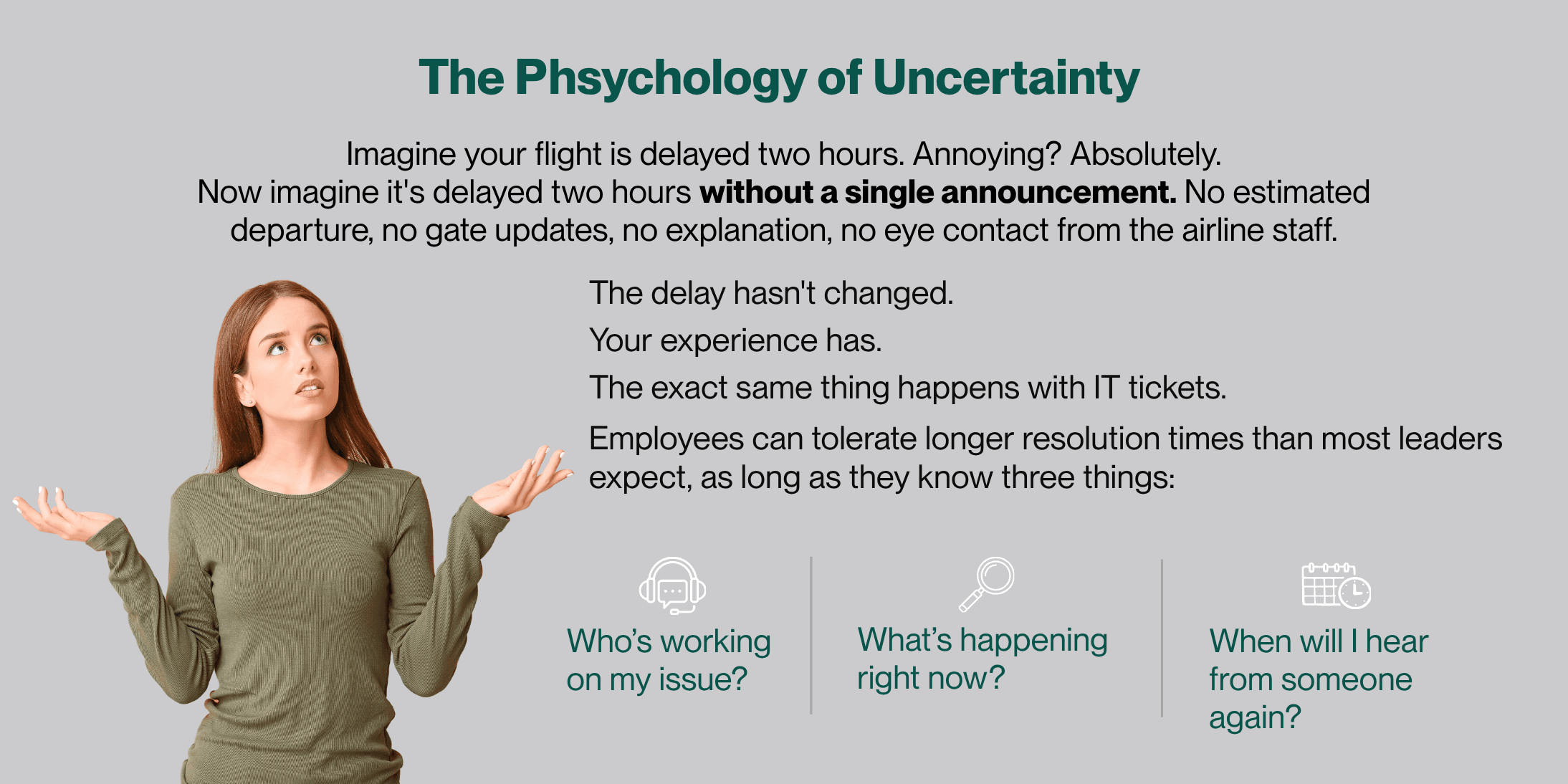
That's why uncertainty creates frustration long before resolution time becomes the problem. Remove any one of those answers and patience quickly turns into suspicion.
The best support experiences aren't always the fastest.
They're the clearest.
Why Great Technicians Still Create Poor Experiences
Communication problems rarely come from technicians who don't care. More often, they come from technicians who are doing exactly what they've been trained to do.
The moment a ticket arrives, their attention shifts to diagnosing the issue, reviewing logs, testing fixes, collaborating with vendors, or reproducing the problem. That's where technical work happens—and it's exactly where it should happen.
The problem is that almost all of that work is invisible to the employee.
Technicians naturally think:
I'll update them once I have something useful.
Employees think:
I haven't heard anything. Did anyone even see my ticket?
Neither perspective is wrong.
They're simply happening in a different order.
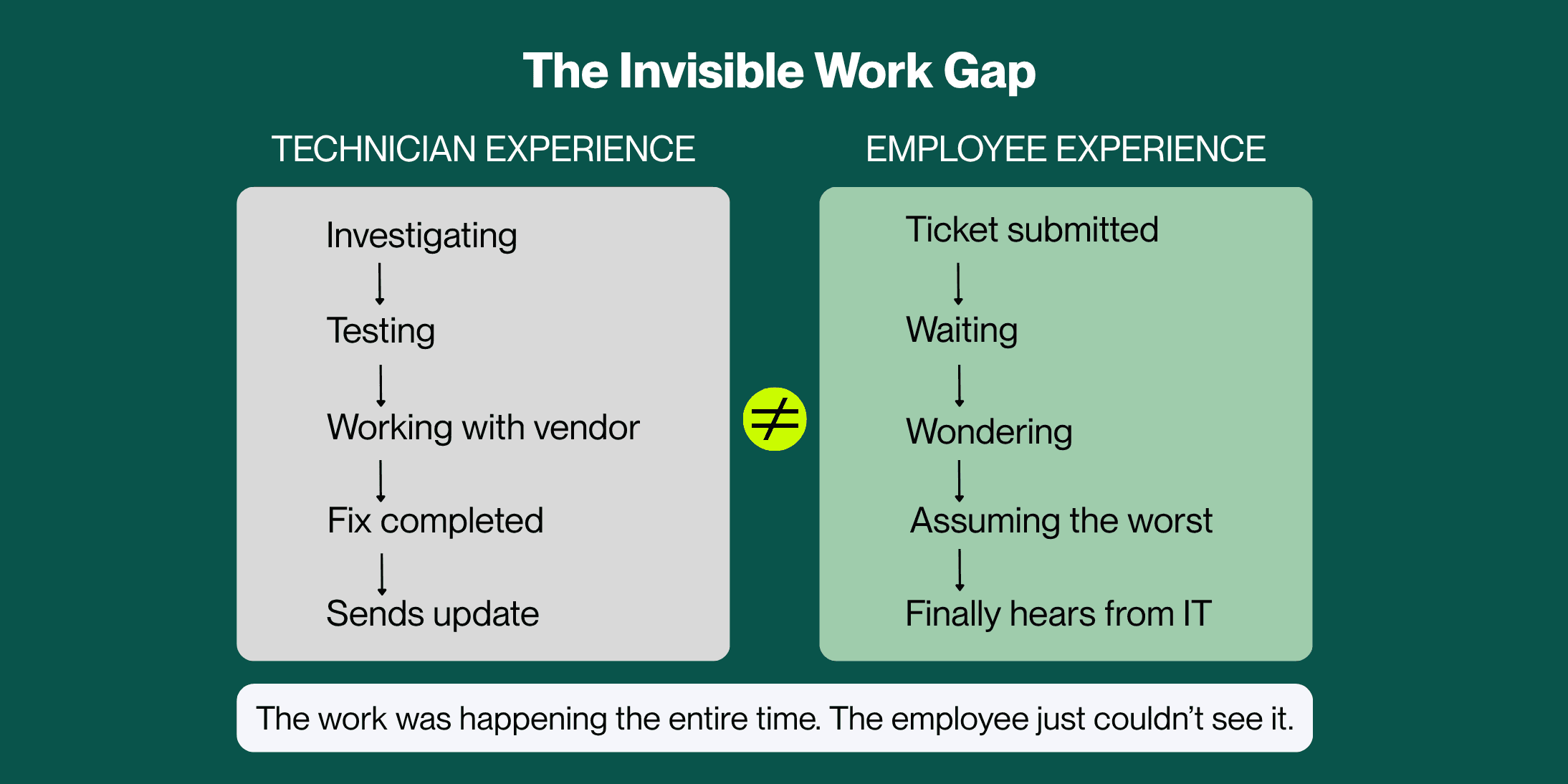
By the time the technician sends their first update, the employee has often spent hours wondering whether anyone was working the ticket at all.
Employees don't need constant communication. They simply need predictable communication.
The exact timing matters less than the consistency. Every ticket should include four predictable moments that remove uncertainty before it turns into frustration.
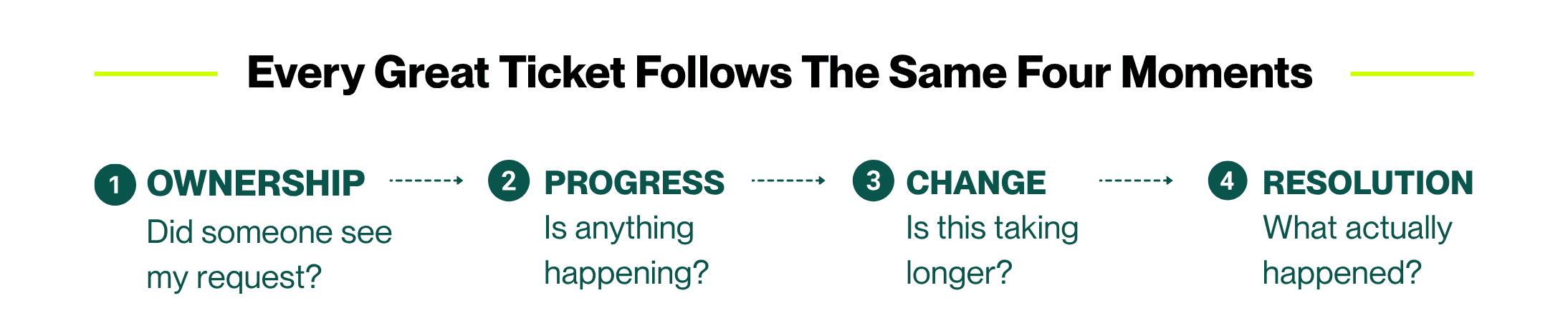
Employees should never wonder whether today will be another day of silence.
Research into proactive customer communication has shown something interesting: sending more updates doesn't necessarily reduce follow-up questions. Sending clearer updates does.
An update like "Still working on it" often creates another email.
An update that explains ownership, progress, and next steps usually doesn't.
Better Updates Build More Trust
Instead of... | Say... |
|---|---|
"Still looking into it." | "We've identified the likely cause and are testing a fix. I'll update you again by 3 PM, even if we're still working through it." |
"Waiting on vendor." | "We've escalated this to our vendor and expect an update within one business day. I'll let you know what we learn tomorrow by noon." |
"No update." | "Nothing has changed yet, but I wanted to let you know your ticket is still being actively worked. My next update will be tomorrow morning." |
The difference isn't optimism. It's confidence.
Employees don't expect every answer immediately. They expect someone to own the conversation.
Give Technicians a Starting Point
Communication standards shouldn't sound robotic.
Simple templates help technicians stay consistent while still making each message their own.
Situation | Example Opening |
|---|---|
🎫 Ownership | "I've started reviewing your request and wanted to let you know I'm on it. I'll send another update by [ time/date ], even if I'm still investigating." |
🔍 Progress | "Quick update: we've isolated the issue and are testing a fix. I'll check back with you [ time/date ]." |
⏳ Delay | "This is taking longer than expected because [ brief explanation ]. I'll reach out again [ time/date ]." |
The goal isn't perfect wording. It's predictable communication.
When Automation Helps (and When It Doesn't)
Automation has a real role here. An automated confirmation reassures an employee that a request landed. Automated status-change notifications keep stakeholders in the loop. Automated reminders help technicians stay consistent with the standard above.
Automation is valuable, but it has limits.
Research on first response time consistently shows that employees who receive a fast, personal acknowledgment, even before their issue is actually fixed, report higher satisfaction than employees who get a faster resolution with no early communication at all. Responsiveness, not just speed to resolution, is its own satisfaction driver. Source: Giva, "Help Desk Description of Duties" → GIVAINC.COM |
|---|
A confirmation email can tell someone their request landed. It can't take ownership of a problem, explain a delay, or rebuild trust after one. Save automation for the routine and predictable. Save a human message for anything involving expectations, delays, priority changes, or a frustrated employee. One confirms. The other reassures. They aren't interchangeable, and no amount of tooling changes that.
The Quiet Ticket Test
Instead of reviewing reports, open any ticket that's been sitting in your queue for more than 24 hours.
Then ask yourself:
If I were the employee...
Would I know who's working on this?
Would I know what's happening?
Would I know when I'll hear from IT again?
If the answer is no, the technical work may be progressing perfectly, but the employee experience isn't.
Every open ticket tells two stories:
One lives inside your PSA.
The other lives inside the employee's head.
When those stories don't match, trust disappears long before the issue is ever resolved.
RELATED RESOURCES
Employees Have Stopped Submitting Tickets. They're Just Working Around You.
Stop Starting Every Incident From Zero
The IT Night Shift You Already Have
Communication Is Part of the Resolution
Great IT support isn't just about solving problems.
It's about making sure employees always know who owns the problem, what's happening, and when they'll hear from you next.
At Helpt, our technicians are trained to treat communication with the same importance as technical resolution because ownership isn't demonstrated when a ticket closes.
It's demonstrated every step of the way.
About the Author

Michelle Burnham has worked in and around the technology industry for nearly a decade; collaborating with IT support teams and contributing to technical documentation, service-oriented content, and operational communications. With a background in editing, formatting, and visual design, she specializes in translating complex ideas into clear, engaging content. In addition to her freelance creative work, she serves as a contract graphic designer, copywriter, and video editor for Helpt.
Silence Is a Status Update
(And It's Usually the Wrong One)
Most frustrated employees aren't waiting for a fix. They're waiting for proof someone owns the problem.
IN THIS ARTICLE
Why silence creates more frustration than slow resolution
The psychology behind uncertain wait times
Why great technicians still create poor experiences
The four communication moments every ticket needs
What good updates actually sound like
When automation helps—and when it hurts
Most employees don't know whether IT is fixing their issue. They know whether someone remembered it.
That's an important distinction because once a ticket goes quiet, people start writing their own story. Maybe it was forgotten. Maybe no one owns it. Maybe IT is overwhelmed again. None of those things have to be true, but silence fills in the blanks long before resolution ever does.
Ask an IT manager what drives ticket dissatisfaction and they'll usually point to resolution time. Ask the employees submitting those tickets and you'll hear something else almost as often:
"I just wanted to know what was going on."
1.77M Employee Responses |
|---|
HappySignals' 2026 Global IT Benchmark analyzed feedback from 1.77 million employees and found that communication remains one of the most common sources of frustration in IT support. Employees consistently rated experiences higher when they knew: ✔ Someone owned the issue ✔ What was happening next ✔ When they'd hear another update The issue wasn't speed alone. It was uncertainty. |
When employees don't know what's happening, they rarely assume the best.
Instead, they assume the ticket was missed, forgotten, or deprioritized. Whether those assumptions are true doesn't really matter. Once trust starts slipping, every unanswered hour reinforces the same story.
That's why uncertainty creates frustration long before resolution time becomes the problem. Remove any one of those answers and patience quickly turns into suspicion.
The best support experiences aren't always the fastest.
They're the clearest.
Why Great Technicians Still Create Poor Experiences
Communication problems rarely come from technicians who don't care. More often, they come from technicians who are doing exactly what they've been trained to do.
The moment a ticket arrives, their attention shifts to diagnosing the issue, reviewing logs, testing fixes, collaborating with vendors, or reproducing the problem. That's where technical work happens—and it's exactly where it should happen.
The problem is that almost all of that work is invisible to the employee.
Technicians naturally think:
I'll update them once I have something useful.
Employees think:
I haven't heard anything. Did anyone even see my ticket?
Neither perspective is wrong.
They're simply happening in a different order.
By the time the technician sends their first update, the employee has often spent hours wondering whether anyone was working the ticket at all.
Employees don't need constant communication. They simply need predictable communication.
The exact timing matters less than the consistency. Every ticket should include four predictable moments that remove uncertainty before it turns into frustration.
Employees should never wonder whether today will be another day of silence.
Research into proactive customer communication has shown something interesting: sending more updates doesn't necessarily reduce follow-up questions. Sending clearer updates does.
An update like "Still working on it" often creates another email.
An update that explains ownership, progress, and next steps usually doesn't.
Better Updates Build More Trust
Instead of... | Say... |
|---|---|
"Still looking into it." | "We've identified the likely cause and are testing a fix. I'll update you again by 3 PM, even if we're still working through it." |
"Waiting on vendor." | "We've escalated this to our vendor and expect an update within one business day. I'll let you know what we learn tomorrow by noon." |
"No update." | "Nothing has changed yet, but I wanted to let you know your ticket is still being actively worked. My next update will be tomorrow morning." |
The difference isn't optimism. It's confidence.
Employees don't expect every answer immediately. They expect someone to own the conversation.
Give Technicians a Starting Point
Communication standards shouldn't sound robotic.
Simple templates help technicians stay consistent while still making each message their own.
Situation | Example Opening |
|---|---|
🎫 Ownership | "I've started reviewing your request and wanted to let you know I'm on it. I'll send another update by [ time/date ], even if I'm still investigating." |
🔍 Progress | "Quick update: we've isolated the issue and are testing a fix. I'll check back with you [ time/date ]." |
⏳ Delay | "This is taking longer than expected because [ brief explanation ]. I'll reach out again [ time/date ]." |
The goal isn't perfect wording. It's predictable communication.
When Automation Helps (and When It Doesn't)
Automation has a real role here. An automated confirmation reassures an employee that a request landed. Automated status-change notifications keep stakeholders in the loop. Automated reminders help technicians stay consistent with the standard above.
Automation is valuable, but it has limits.
Research on first response time consistently shows that employees who receive a fast, personal acknowledgment, even before their issue is actually fixed, report higher satisfaction than employees who get a faster resolution with no early communication at all. Responsiveness, not just speed to resolution, is its own satisfaction driver. Source: Giva, "Help Desk Description of Duties" → GIVAINC.COM |
|---|
A confirmation email can tell someone their request landed. It can't take ownership of a problem, explain a delay, or rebuild trust after one. Save automation for the routine and predictable. Save a human message for anything involving expectations, delays, priority changes, or a frustrated employee. One confirms. The other reassures. They aren't interchangeable, and no amount of tooling changes that.
The Quiet Ticket Test
Instead of reviewing reports, open any ticket that's been sitting in your queue for more than 24 hours.
Then ask yourself:
If I were the employee...
Would I know who's working on this?
Would I know what's happening?
Would I know when I'll hear from IT again?
If the answer is no, the technical work may be progressing perfectly, but the employee experience isn't.
Every open ticket tells two stories:
One lives inside your PSA.
The other lives inside the employee's head.
When those stories don't match, trust disappears long before the issue is ever resolved.
RELATED RESOURCES
Employees Have Stopped Submitting Tickets. They're Just Working Around You.
Stop Starting Every Incident From Zero
The IT Night Shift You Already Have
Communication Is Part of the Resolution
Great IT support isn't just about solving problems.
It's about making sure employees always know who owns the problem, what's happening, and when they'll hear from you next.
At Helpt, our technicians are trained to treat communication with the same importance as technical resolution because ownership isn't demonstrated when a ticket closes.
It's demonstrated every step of the way.
About the Author
Michelle Burnham has worked in and around the technology industry for nearly a decade; collaborating with IT support teams and contributing to technical documentation, service-oriented content, and operational communications. With a background in editing, formatting, and visual design, she specializes in translating complex ideas into clear, engaging content. In addition to her freelance creative work, she serves as a contract graphic designer, copywriter, and video editor for Helpt.
Stop Answering Calls.
Start Driving Growth.
Let Helpt's US-based technicians handle your support calls 24x7 while your team focuses on what matters most.
Stop Answering Calls.
Start Driving Growth.
Let Helpt's US-based technicians handle your support calls 24x7 while your team focuses on what matters most.
Stop Answering Calls.
Start Driving Growth.
Let Helpt's US-based technicians handle your support calls 24x7 while your team focuses on what matters most.
©2026 Helpt, a part of PAG Technology Inc. All Rights Reserved.