The First Fix Isn't Technical: How Frontline Technicians De-escalate Difficult Calls

The best technicians aren't born calm. They use repeatable techniques to keep frustrated calls focused on solving the problem.
IN THIS ARTICLE
Why IT de-escalation matters more than ever
De-escalate yourself before the user
Five practical IT de-escalation techniques
Sometimes the best solution is escalation
Small language swaps that prevent conflict
Why this matters for IT managers
The takeaway
Picture this. A user picks up the phone already frustrated, and within thirty seconds they're raising their voice. The technician on the other end feels it immediately. Pulse spikes. Hands go a little unsteady. Not from fear exactly, more like a primal response kicking in, the body preparing to protect itself or get out of the room.
Every instinct says defend yourself. Explain that the outage isn't your fault. Point out you've been on the call for less than a minute. Remind them you're trying to help.
But the moment a technician starts defending themselves, the conversation stops being about solving the problem. It becomes a conflict.
The technicians who consistently earn trust from employees aren't necessarily the most technically advanced. They're the ones who can force their voice to stay level, keep the tremor out of it, and guide a frustrated user toward a solution even while their own adrenaline is spiking. That skill has a name: IT de-escalation. And the good news for managers is that it can be taught, coached, and repeated.
Why IT De-escalation Matters More Than Ever
When employees contact IT, they're rarely calling because things are going well. Something is stopping them from doing their job, and that frustration often arrives before the technician says hello.
76.7
In Q1 2026, the American Customer Satisfaction Index fell to 76.7 on a 100-point scale, the same level it sat at back in 2013, while customer complaints jumped 16% to a record high. Support interactions across every industry are starting from a lower baseline of patience than they used to.
Internal IT is not the same as retail customer service, but the pattern holds. Most tickets do not arrive charged with emotion.
82%
Fixify's 2026 IT Help Desk Benchmark found that 82% of tickets come in with no emotional charge at all, just a plain description of the problem. That means the remaining 18% are the calls that decide how an employee remembers IT altogether, and where de-escalation skills earn their keep.
Before You De-escalate the User, De-escalate Yourself
Many technicians assume de-escalation starts with the person on the other end of the line. In reality, it starts with them.
When someone is upset, the body reacts before the brain catches up. Heart rate climbs. Breathing changes. The urge to interrupt or explain shows up fast. Recognizing that reaction, and slowing it down on purpose, is the real first move.
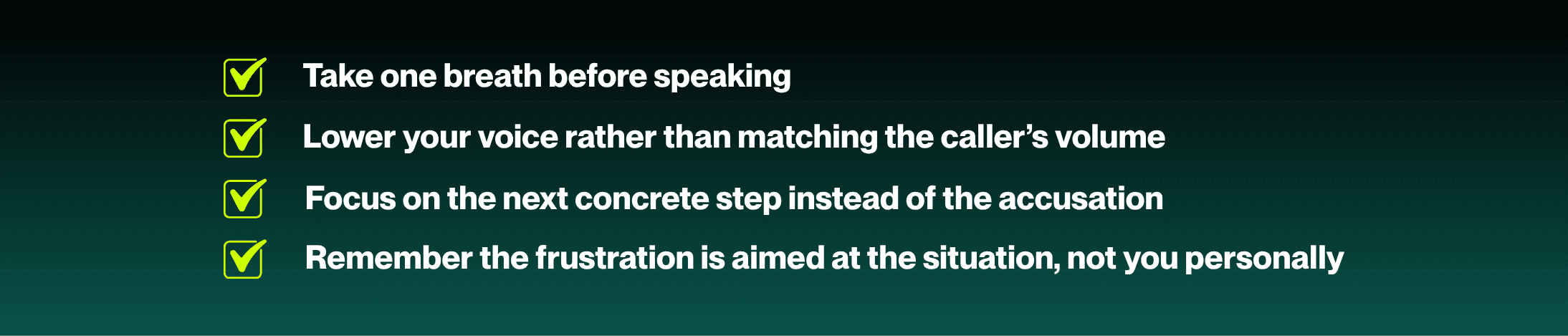
That short mental reset is what makes the five techniques below possible. Experienced technicians often notice something surprising. Once they've confirmed an issue truly requires another team, a vendor, or an engineer, they actually become calmer. There is nothing left to defend. Their role shifts from fixing the problem to managing the employee's experience.
Five Practical IT De-escalation Techniques
1. Acknowledge before troubleshooting.
Acknowledging impact is not the same as admitting fault. Before jumping into diagnostic questions, try: "I can understand why that's frustrating, especially if you're trying to get this done today. Let's work through it together." Acknowledgment lowers emotional effort before a single fix is applied.
Research from the Customer Contact Council, published in Harvard Business Review, found that reducing customer effort often does more for satisfaction than exceeding expectations, which is exactly what acknowledgment does before a fix is even applied.
2. Match urgency without matching emotion.
Calm does not mean slow, and users want to know their issue is being taken seriously. A line like "I understand this is impacting your work, let's see what we can do right now" signals urgency without absorbing the caller's frustration. The technician isn't arguing or telling anyone to relax. They're redirecting energy toward progress, which is often enough to lower the temperature on its own.
3. Clarify the desired outcome.
Frustrated users often describe symptoms, prior attempts, and unrelated complaints all at once. Asking "What would a successful resolution look like right now?" cuts through the noise. Sometimes a user who initially demands full access to a broken application only needs one report before a meeting, and a quick workaround solves the immediate problem while the real fix gets investigated properly.
4. Explain the next step out loud.
Silence creates uncertainty, uncertainty creates anxiety, and anxiety creates more frustration. Narrating the process, "I'm checking the authentication logs now to see if this is account or system related," keeps a user anchored in what's happening instead of guessing. We covered this idea in more depth in Silence Is a Status Update, including why communication gaps tend to damage trust faster than technical delays ever do.
5. Close with ownership.
A call should never end in ambiguity. Even an unresolved issue needs a clear owner and a clear next update, such as "I'll keep working on this and update you by 3:00 PM, even without a final answer yet." Ownership signals accountability. Its absence is what generates repeat calls and a lower opinion of IT overall.
Sometimes the Best Solution Is Escalation
New technicians often believe they need to personally solve every problem. They don't. Some issues belong with an engineer, a vendor, or someone with management approval, and once a technician has genuinely exhausted their own tools, continuing to fight for an answer rarely improves the experience for anyone.
How that handoff gets communicated matters more than people expect.
+85 → +52
HappySignals' Global IT Benchmark 2026 found that employee happiness scores drop from +85 to +52 as ticket reassignments increase. The escalation itself is not what erodes trust. An escalation with no explanation, no timeline, and no clear point of contact is.
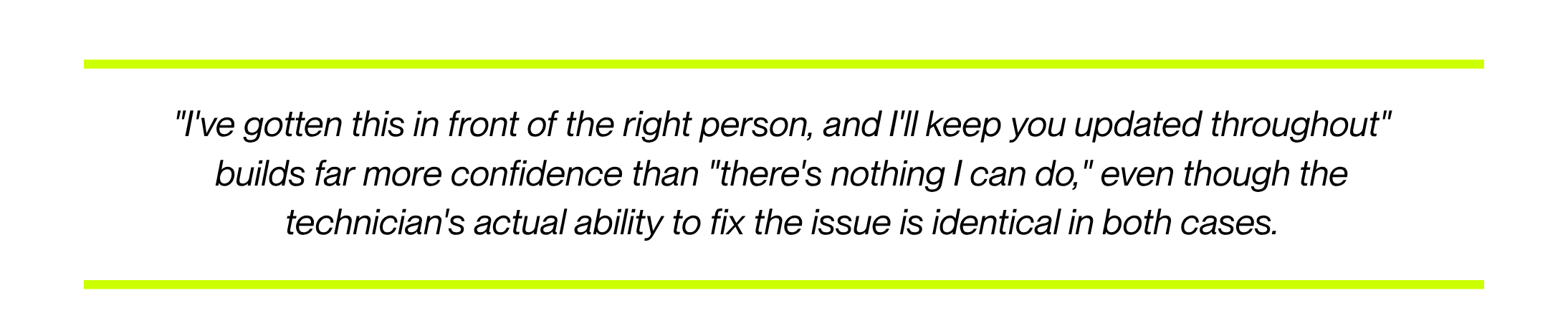
Once an issue moves beyond a technician's control, their job doesn't end. It changes. Their role becomes explaining why the issue is being escalated, setting realistic expectations, and making sure the employee never feels abandoned.
Small Language Swaps That Prevent Escalation
Many conflicts can be avoided just by adjusting a few habitual phrases. The goal isn't to sound scripted. It's to communicate partnership instead of resistance.
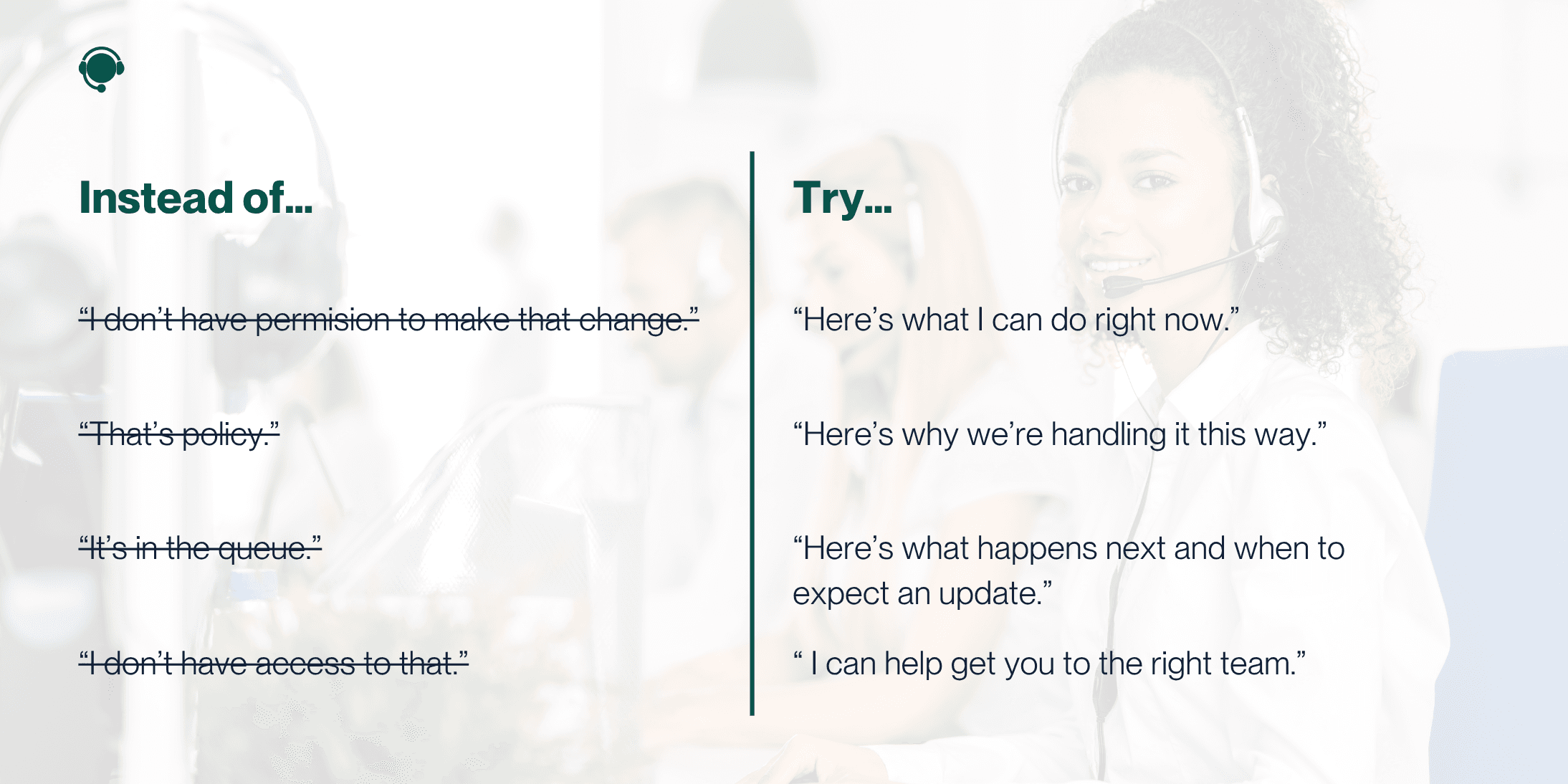
Small wording changes like these consistently show up in de-escalation training because they shift a caller's attention from a limitation to an action.
Why IT De-escalation Skills Matter for Managers
De-escalation training is easy to overlook because it feels less measurable than technical training, but the impact on retention and satisfaction is real. Constantly absorbing angry calls without a repeatable framework is exhausting, and it wears on technicians faster on small teams where every interaction is visible and every technician carries a heavier share of the queue.
As we discussed in Low CSAT Isn't a Verdict, It's a Starting Point, satisfaction is shaped by how users feel throughout the entire support journey, not just how fast a ticket closes. And as we explored in Your SLAs Are Excellent. So Why Are Users Still Frustrated?, employees often judge IT on the interaction itself long before they judge the fix. IT de-escalation sits right at the center of both, because it is teachable in a way that raw patience is not.
The Takeaway
Most users don't call IT on their best day. They're stressed, they're blocked from doing their job, and once in a while they take that pressure out on the person trying to help them.
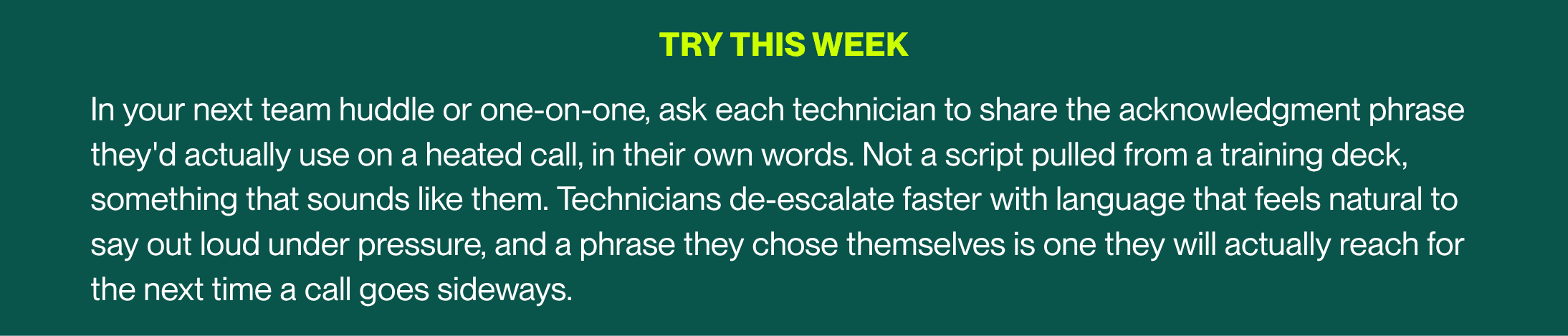
Because long after the technical details are forgotten, employees remember how they were treated when they needed help the most.
About the Author

Michelle Burnham has worked in and around the technology industry for nearly a decade; collaborating with IT support teams and contributing to technical documentation, service-oriented content, and operational communications. With a background in editing, formatting, and visual design, she specializes in translating complex ideas into clear, engaging content. In addition to her freelance creative work, she serves as a contract graphic designer, copywriter, and video editor for Helpt.
The best technicians aren't born calm. They use repeatable techniques to keep frustrated calls focused on solving the problem.
IN THIS ARTICLE
Why IT de-escalation matters more than ever
De-escalate yourself before the user
Five practical IT de-escalation techniques
Sometimes the best solution is escalation
Small language swaps that prevent conflict
Why this matters for IT managers
The takeaway
Picture this. A user picks up the phone already frustrated, and within thirty seconds they're raising their voice. The technician on the other end feels it immediately. Pulse spikes. Hands go a little unsteady. Not from fear exactly, more like a primal response kicking in, the body preparing to protect itself or get out of the room.
Every instinct says defend yourself. Explain that the outage isn't your fault. Point out you've been on the call for less than a minute. Remind them you're trying to help.
But the moment a technician starts defending themselves, the conversation stops being about solving the problem. It becomes a conflict.
The technicians who consistently earn trust from employees aren't necessarily the most technically advanced. They're the ones who can force their voice to stay level, keep the tremor out of it, and guide a frustrated user toward a solution even while their own adrenaline is spiking. That skill has a name: IT de-escalation. And the good news for managers is that it can be taught, coached, and repeated.
Why IT De-escalation Matters More Than Ever
When employees contact IT, they're rarely calling because things are going well. Something is stopping them from doing their job, and that frustration often arrives before the technician says hello.
76.7
In Q1 2026, the American Customer Satisfaction Index fell to 76.7 on a 100-point scale, the same level it sat at back in 2013, while customer complaints jumped 16% to a record high. Support interactions across every industry are starting from a lower baseline of patience than they used to.
Internal IT is not the same as retail customer service, but the pattern holds. Most tickets do not arrive charged with emotion.
82%
Fixify's 2026 IT Help Desk Benchmark found that 82% of tickets come in with no emotional charge at all, just a plain description of the problem. That means the remaining 18% are the calls that decide how an employee remembers IT altogether, and where de-escalation skills earn their keep.
Before You De-escalate the User, De-escalate Yourself
Many technicians assume de-escalation starts with the person on the other end of the line. In reality, it starts with them.
When someone is upset, the body reacts before the brain catches up. Heart rate climbs. Breathing changes. The urge to interrupt or explain shows up fast. Recognizing that reaction, and slowing it down on purpose, is the real first move.
That short mental reset is what makes the five techniques below possible. Experienced technicians often notice something surprising. Once they've confirmed an issue truly requires another team, a vendor, or an engineer, they actually become calmer. There is nothing left to defend. Their role shifts from fixing the problem to managing the employee's experience.
Five Practical IT De-escalation Techniques
1. Acknowledge before troubleshooting.
Acknowledging impact is not the same as admitting fault. Before jumping into diagnostic questions, try: "I can understand why that's frustrating, especially if you're trying to get this done today. Let's work through it together." Acknowledgment lowers emotional effort before a single fix is applied.
Research from the Customer Contact Council, published in Harvard Business Review, found that reducing customer effort often does more for satisfaction than exceeding expectations, which is exactly what acknowledgment does before a fix is even applied.
2. Match urgency without matching emotion.
Calm does not mean slow, and users want to know their issue is being taken seriously. A line like "I understand this is impacting your work, let's see what we can do right now" signals urgency without absorbing the caller's frustration. The technician isn't arguing or telling anyone to relax. They're redirecting energy toward progress, which is often enough to lower the temperature on its own.
3. Clarify the desired outcome.
Frustrated users often describe symptoms, prior attempts, and unrelated complaints all at once. Asking "What would a successful resolution look like right now?" cuts through the noise. Sometimes a user who initially demands full access to a broken application only needs one report before a meeting, and a quick workaround solves the immediate problem while the real fix gets investigated properly.
4. Explain the next step out loud.
Silence creates uncertainty, uncertainty creates anxiety, and anxiety creates more frustration. Narrating the process, "I'm checking the authentication logs now to see if this is account or system related," keeps a user anchored in what's happening instead of guessing. We covered this idea in more depth in Silence Is a Status Update, including why communication gaps tend to damage trust faster than technical delays ever do.
5. Close with ownership.
A call should never end in ambiguity. Even an unresolved issue needs a clear owner and a clear next update, such as "I'll keep working on this and update you by 3:00 PM, even without a final answer yet." Ownership signals accountability. Its absence is what generates repeat calls and a lower opinion of IT overall.
Sometimes the Best Solution Is Escalation
New technicians often believe they need to personally solve every problem. They don't. Some issues belong with an engineer, a vendor, or someone with management approval, and once a technician has genuinely exhausted their own tools, continuing to fight for an answer rarely improves the experience for anyone.
How that handoff gets communicated matters more than people expect.
+85 → +52
HappySignals' Global IT Benchmark 2026 found that employee happiness scores drop from +85 to +52 as ticket reassignments increase. The escalation itself is not what erodes trust. An escalation with no explanation, no timeline, and no clear point of contact is.
Once an issue moves beyond a technician's control, their job doesn't end. It changes. Their role becomes explaining why the issue is being escalated, setting realistic expectations, and making sure the employee never feels abandoned.
Small Language Swaps That Prevent Escalation
Many conflicts can be avoided just by adjusting a few habitual phrases. The goal isn't to sound scripted. It's to communicate partnership instead of resistance.
Small wording changes like these consistently show up in de-escalation training because they shift a caller's attention from a limitation to an action.
Why IT De-escalation Skills Matter for Managers
De-escalation training is easy to overlook because it feels less measurable than technical training, but the impact on retention and satisfaction is real. Constantly absorbing angry calls without a repeatable framework is exhausting, and it wears on technicians faster on small teams where every interaction is visible and every technician carries a heavier share of the queue.
As we discussed in Low CSAT Isn't a Verdict, It's a Starting Point, satisfaction is shaped by how users feel throughout the entire support journey, not just how fast a ticket closes. And as we explored in Your SLAs Are Excellent. So Why Are Users Still Frustrated?, employees often judge IT on the interaction itself long before they judge the fix. IT de-escalation sits right at the center of both, because it is teachable in a way that raw patience is not.
The Takeaway
Most users don't call IT on their best day. They're stressed, they're blocked from doing their job, and once in a while they take that pressure out on the person trying to help them.
Because long after the technical details are forgotten, employees remember how they were treated when they needed help the most.
About the Author
Michelle Burnham has worked in and around the technology industry for nearly a decade; collaborating with IT support teams and contributing to technical documentation, service-oriented content, and operational communications. With a background in editing, formatting, and visual design, she specializes in translating complex ideas into clear, engaging content. In addition to her freelance creative work, she serves as a contract graphic designer, copywriter, and video editor for Helpt.
Stop Answering Calls.
Start Driving Growth.
Let Helpt's US-based technicians handle your support calls 24x7 while your team focuses on what matters most.
Stop Answering Calls.
Start Driving Growth.
Let Helpt's US-based technicians handle your support calls 24x7 while your team focuses on what matters most.
Stop Answering Calls.
Start Driving Growth.
Let Helpt's US-based technicians handle your support calls 24x7 while your team focuses on what matters most.
©2026 Helpt, a part of PAG Technology Inc. All Rights Reserved.