The Vanishing Roadmap: Why Strategic Projects Keep Losing to Whatever's on Fire Today

Your modernization plan isn't dead. It's just been in the waiting room since March.
~8 min read · IT Managers & Directors · IT Project Management
IN THIS ARTICLE
Why Urgent Work Always Wins
Give Strategic Work a Real Address
Don't Protect Every Project. Protect the Right Ones.
Let Your Ticket Queue Write the Roadmap
Measure the Capacity You Get Back
Leadership asks what happened to the project. You know the answer before they finish the sentence: the team got busy.
A critical issue came up. A technician called out. A VP couldn't log in twenty minutes before a board meeting. Then another "quick" request landed in the queue. The project got pushed to next week. Then next month. Eventually it's still sitting on the roadmap in a slide nobody has opened since Q1, technically alive, functionally a ghost.
For IT Managers and Directors running lean teams of two to ten technicians, this isn't a prioritization problem. You know what matters. It's a priority structure problem: your operation has no mechanism that lets important work survive contact with urgent work.
Picture the MFA rollout. It's been "starting Monday" for three months, and every Monday a wave of password-reset tickets swallows the block you'd set aside for it. The rollout isn't stalled because anyone forgot it. It's stalled because the hours keep getting spent on the thing that's already on fire.
Urgent Work Doesn't Ask Permission
Picture two tasks on your plate. One is a user locked out of a business-critical app. The other is a network modernization project that will quietly prevent next quarter's outages. Which one gets your attention in the next five minutes?
The user can't work right now. The modernization project, annoyingly, can wait. That's the trap: urgent work is self-prioritizing, and strategic work is not. Nothing about a roadmap item pings your phone at 8:47 a.m. If every incoming request is allowed to interrupt every existing priority, your roadmap stops being a roadmap. It becomes a wish list that gets whatever scraps of time are left over, which most weeks is none.
23:15 min — the average time it takes a knowledge worker to fully refocus after a single interruption, according to ongoing research from UC Irvine informatics professor Gloria Mark. The American Psychological Association's review of task-switching research puts the productivity hit at up to 40% on complex work. That's the math behind the vanished project hours: every "quick question" your team fields doesn't just cost five minutes. It costs five minutes plus the twenty-three it takes to climb back to where they were.
It gets worse before it gets better. Every deferred project is a small loan against your future capacity, and like any loan, it accrues interest.
~80% of IT decision-makers say the time, money, and effort spent maintaining legacy systems could be spent more productively on other projects. That's your strategic roadmap, sitting behind a wall of maintenance work almost everyone agrees shouldn't be there, and the longer it sits, the taller that wall grows.
SOURCE: Pegasystems / Savanta, Oct. 2026
And here's the loop that keeps IT leaders up at night: more reactive work leads to less project time, which leads to more deferred improvements, which leads to more technical debt, which leads to more reactive work. Breaking that cycle takes more than adding one more line item to the roadmap. It takes changing how time gets claimed in the first place.

Give Strategic Work a Real Address
Step one is almost embarrassingly simple: stop treating project time as leftover capacity. If a project only advances when there are zero tickets, zero escalations, and zero surprises, it will never advance consistently, because there is always something.
Strategic work needs a defined place in your team's operating rhythm. For a lean team, that doesn't have to mean blocking an entire day. It could mean:
PICK YOUR CAPACITY MODEL
A recurring project block for one technician each week
A rotating project owner while the rest of the team covers frontline support
A defined minimum number of project hours per week, tracked like any other metric
A protected half-day tied to one specific initiative
A monthly milestone instead of a vague "someday" completion date
The exact structure matters less than the underlying rule: project work needs scheduled capacity, not leftover capacity. Most roadmaps estimate the work. They rarely reserve the hours. That gap is where strategic projects disappear, and it's why a 60-hour project takes six months. Not because the work is hard, but because those 60 hours never exist in one protected place.
Don't Protect Every Project. Protect the Right Ones.
Once leadership accepts that strategic work needs protected time, the next temptation is to protect everything. Every initiative feels important. Every department has a request. Your team is quietly expected to complete all of it while also keeping the lights on.
That's not prioritization. That's just a longer list with better formatting.
You don't need to reevaluate your entire roadmap at once. Start with the next project competing for your team's time and put it in one of three lanes:

You're not the only one who finds this hard. Resource management and project prioritization are still the two toughest capabilities for organizations to institutionalize, according to Wellingtone's 2025 State of Project Management research, and nearly half of respondents say they're dissatisfied with their organization's project management maturity overall. A simple lane filter won't fix that overnight, but it turns prioritization from a gut call into a conversation your whole team can actually have. (Wellingtone, 2025)
Let Your Ticket Queue Write the Roadmap
Instead of treating tickets as the enemy of strategic work, treat them as its source material. Your ticket queue already ranks your roadmap for you; you just haven't translated it. The next time you close the same ticket for the third time, that's a roadmap item. The system demanding the most manual attention is usually the system most worth fixing.
That password-reset surge that keeps eating your MFA block? It isn't an interruption to your roadmap. It IS your roadmap: the queue telling you exactly where proactive work would pay back fastest.
EARLIER IN THIS SERIES
We dug into why outages get reported by frustrated users before your monitoring tools ever notice. Read: Your First Ticket Is Already Late
Draw a Real Interruption Line
"Have a plan for interruptions" is not a plan. Here's an actual rule you can put in writing:
Only a business-wide outage or a critical-department-down event breaks a project block. Everything else waits for the normal queue. And if a block does get interrupted, the lost hours get rescheduled, not deleted.
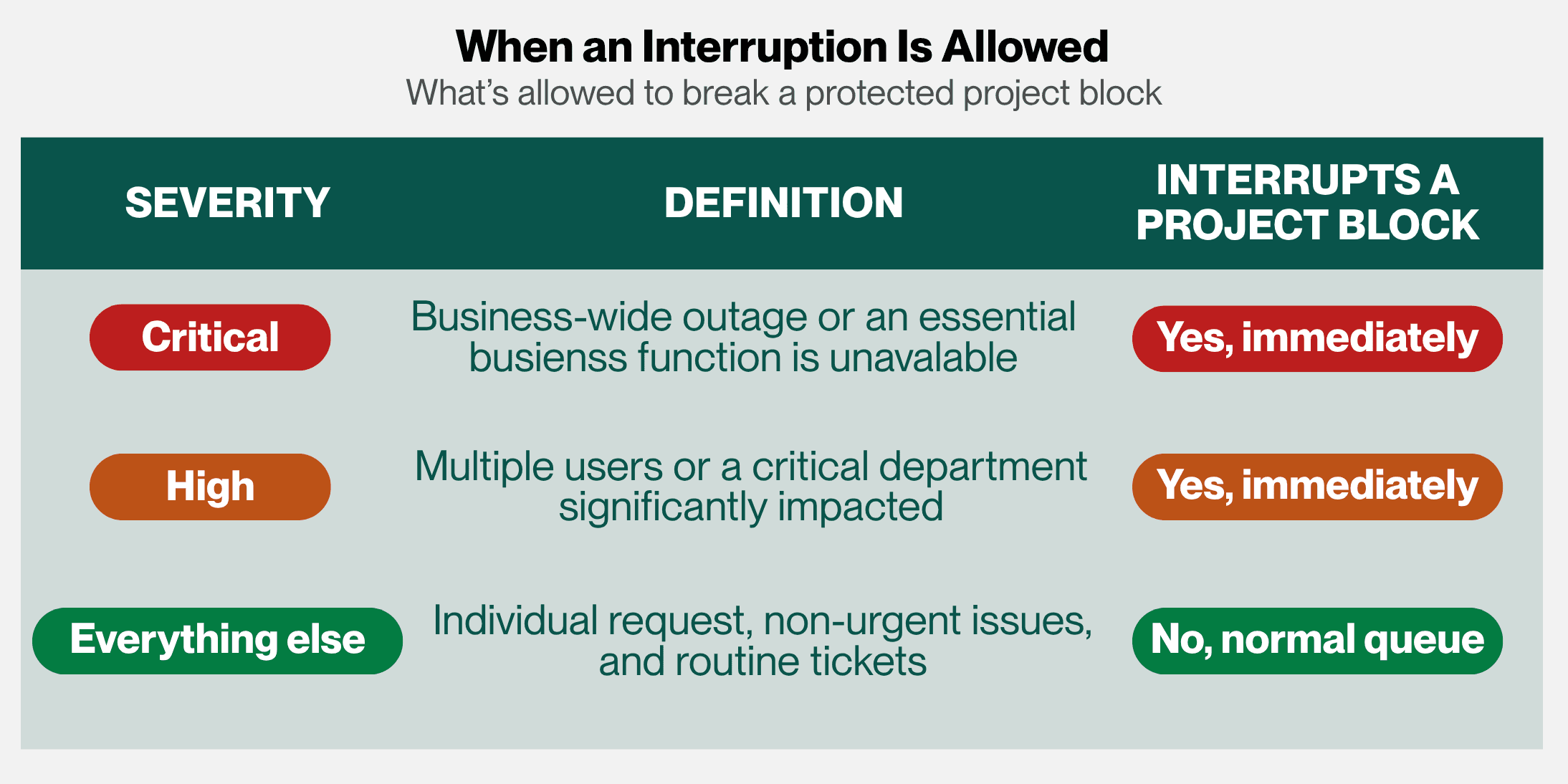
A rule with no rescheduling step isn't a rule. It's a permission slip for the project to disappear.
Measure the Capacity You Get Back
Project completion matters, but it's not the only outcome worth tracking. Also measure hours of recurring support eliminated, incidents prevented, systems retired, manual processes removed, and support volume before and after implementation.
Every hour of recurring work a project removes is an hour you get back, month after month. Eliminate 15 hours of repeat tickets a month and you haven't just closed a project; you've bought back 15 hours of capacity. That's the number to put in front of leadership: not "project completed," but "15 hours of technician capacity recovered each month."
EARLIER IN THIS SERIES
If your team is still stuck in firefighting mode, start here. Read: The Best Ticket Is the One You Never Receive Again
Make Progress Impossible to Ignore
There's one more reason projects get shelved: once they're delayed, people stop asking about them. Silence reads as low priority, even when it's really just fatigue. A project nobody is tracking is a project that's easy to deprioritize without anyone deciding to.
Give leadership a four-line update instead of a status meeting:
Progress: what actually moved since the last update.
Next: what's happening next, and by when.
Blocker: what's slowing it down right now.
Tradeoff: what has to move if leadership wants this faster.
This isn't a report for the sake of reporting. It's how you make the tradeoffs visible in real time.
11% project failure rate for teams without strong business acumen and visibility practices, nearly a coin flip on which initiatives stall out. 8% is the failure rate for teams that track business context and communicate tradeoffs consistently. Visibility alone moves the number by roughly a third. That's the cheapest project-management investment most IT teams still haven't made.
THE GOAL ISN'T PERFECT BALANCE
There will be weeks when support wins outright. There will be outages, callouts, and emergencies that genuinely deserve your team's full attention. The goal was never to divide every week perfectly between "urgent" and "important." It's to keep a temporary imbalance from quietly becoming your permanent operating model.
If a project loses a week because of a real outage, that's normal operations. If it loses six months because there's always another urgent request, that's a system problem wearing a busy-team disguise. Reactive work is part of IT. It should never be allowed to define IT.
✓ Rescue One Stalled Project This Week
Don't try to rebuild the entire roadmap. Look at the project that's been pushed the longest and answer one question:
What would have to be protected, moved, or stopped for this project to make meaningful progress next week?
That's the conversation to have with leadership. Don't ask your team to "find time." Decide where the time is coming from.
Strategic IT work gets finished when the organization gives it a defined place in how IT actually operates, not a hopeful line on a slide. And when your roadmap is designed to eliminate tomorrow's support burden, strategic work stops competing with day-to-day operations entirely. It becomes how you improve them.
About the Author

Michelle Burnham has worked in and around the technology industry for nearly a decade; collaborating with IT support teams and contributing to technical documentation, service-oriented content, and operational communications. With a background in editing, formatting, and visual design, she specializes in translating complex ideas into clear, engaging content. In addition to her freelance creative work, she serves as a contract graphic designer, copywriter, and video editor for Helpt.
Your modernization plan isn't dead. It's just been in the waiting room since March.
~8 min read · IT Managers & Directors · IT Project Management
IN THIS ARTICLE
Why Urgent Work Always Wins
Give Strategic Work a Real Address
Don't Protect Every Project. Protect the Right Ones.
Let Your Ticket Queue Write the Roadmap
Measure the Capacity You Get Back
Leadership asks what happened to the project. You know the answer before they finish the sentence: the team got busy.
A critical issue came up. A technician called out. A VP couldn't log in twenty minutes before a board meeting. Then another "quick" request landed in the queue. The project got pushed to next week. Then next month. Eventually it's still sitting on the roadmap in a slide nobody has opened since Q1, technically alive, functionally a ghost.
For IT Managers and Directors running lean teams of two to ten technicians, this isn't a prioritization problem. You know what matters. It's a priority structure problem: your operation has no mechanism that lets important work survive contact with urgent work.
Picture the MFA rollout. It's been "starting Monday" for three months, and every Monday a wave of password-reset tickets swallows the block you'd set aside for it. The rollout isn't stalled because anyone forgot it. It's stalled because the hours keep getting spent on the thing that's already on fire.
Urgent Work Doesn't Ask Permission
Picture two tasks on your plate. One is a user locked out of a business-critical app. The other is a network modernization project that will quietly prevent next quarter's outages. Which one gets your attention in the next five minutes?
The user can't work right now. The modernization project, annoyingly, can wait. That's the trap: urgent work is self-prioritizing, and strategic work is not. Nothing about a roadmap item pings your phone at 8:47 a.m. If every incoming request is allowed to interrupt every existing priority, your roadmap stops being a roadmap. It becomes a wish list that gets whatever scraps of time are left over, which most weeks is none.
23:15 min — the average time it takes a knowledge worker to fully refocus after a single interruption, according to ongoing research from UC Irvine informatics professor Gloria Mark. The American Psychological Association's review of task-switching research puts the productivity hit at up to 40% on complex work. That's the math behind the vanished project hours: every "quick question" your team fields doesn't just cost five minutes. It costs five minutes plus the twenty-three it takes to climb back to where they were.
It gets worse before it gets better. Every deferred project is a small loan against your future capacity, and like any loan, it accrues interest.
~80% of IT decision-makers say the time, money, and effort spent maintaining legacy systems could be spent more productively on other projects. That's your strategic roadmap, sitting behind a wall of maintenance work almost everyone agrees shouldn't be there, and the longer it sits, the taller that wall grows.
SOURCE: Pegasystems / Savanta, Oct. 2026
And here's the loop that keeps IT leaders up at night: more reactive work leads to less project time, which leads to more deferred improvements, which leads to more technical debt, which leads to more reactive work. Breaking that cycle takes more than adding one more line item to the roadmap. It takes changing how time gets claimed in the first place.
Give Strategic Work a Real Address
Step one is almost embarrassingly simple: stop treating project time as leftover capacity. If a project only advances when there are zero tickets, zero escalations, and zero surprises, it will never advance consistently, because there is always something.
Strategic work needs a defined place in your team's operating rhythm. For a lean team, that doesn't have to mean blocking an entire day. It could mean:
PICK YOUR CAPACITY MODEL
A recurring project block for one technician each week
A rotating project owner while the rest of the team covers frontline support
A defined minimum number of project hours per week, tracked like any other metric
A protected half-day tied to one specific initiative
A monthly milestone instead of a vague "someday" completion date
The exact structure matters less than the underlying rule: project work needs scheduled capacity, not leftover capacity. Most roadmaps estimate the work. They rarely reserve the hours. That gap is where strategic projects disappear, and it's why a 60-hour project takes six months. Not because the work is hard, but because those 60 hours never exist in one protected place.
Don't Protect Every Project. Protect the Right Ones.
Once leadership accepts that strategic work needs protected time, the next temptation is to protect everything. Every initiative feels important. Every department has a request. Your team is quietly expected to complete all of it while also keeping the lights on.
That's not prioritization. That's just a longer list with better formatting.
You don't need to reevaluate your entire roadmap at once. Start with the next project competing for your team's time and put it in one of three lanes:
You're not the only one who finds this hard. Resource management and project prioritization are still the two toughest capabilities for organizations to institutionalize, according to Wellingtone's 2025 State of Project Management research, and nearly half of respondents say they're dissatisfied with their organization's project management maturity overall. A simple lane filter won't fix that overnight, but it turns prioritization from a gut call into a conversation your whole team can actually have. (Wellingtone, 2025)
Let Your Ticket Queue Write the Roadmap
Instead of treating tickets as the enemy of strategic work, treat them as its source material. Your ticket queue already ranks your roadmap for you; you just haven't translated it. The next time you close the same ticket for the third time, that's a roadmap item. The system demanding the most manual attention is usually the system most worth fixing.
That password-reset surge that keeps eating your MFA block? It isn't an interruption to your roadmap. It IS your roadmap: the queue telling you exactly where proactive work would pay back fastest.
EARLIER IN THIS SERIES
We dug into why outages get reported by frustrated users before your monitoring tools ever notice. Read: Your First Ticket Is Already Late
Draw a Real Interruption Line
"Have a plan for interruptions" is not a plan. Here's an actual rule you can put in writing:
Only a business-wide outage or a critical-department-down event breaks a project block. Everything else waits for the normal queue. And if a block does get interrupted, the lost hours get rescheduled, not deleted.
A rule with no rescheduling step isn't a rule. It's a permission slip for the project to disappear.
Measure the Capacity You Get Back
Project completion matters, but it's not the only outcome worth tracking. Also measure hours of recurring support eliminated, incidents prevented, systems retired, manual processes removed, and support volume before and after implementation.
Every hour of recurring work a project removes is an hour you get back, month after month. Eliminate 15 hours of repeat tickets a month and you haven't just closed a project; you've bought back 15 hours of capacity. That's the number to put in front of leadership: not "project completed," but "15 hours of technician capacity recovered each month."
EARLIER IN THIS SERIES
If your team is still stuck in firefighting mode, start here. Read: The Best Ticket Is the One You Never Receive Again
Make Progress Impossible to Ignore
There's one more reason projects get shelved: once they're delayed, people stop asking about them. Silence reads as low priority, even when it's really just fatigue. A project nobody is tracking is a project that's easy to deprioritize without anyone deciding to.
Give leadership a four-line update instead of a status meeting:
Progress: what actually moved since the last update.
Next: what's happening next, and by when.
Blocker: what's slowing it down right now.
Tradeoff: what has to move if leadership wants this faster.
This isn't a report for the sake of reporting. It's how you make the tradeoffs visible in real time.
11% project failure rate for teams without strong business acumen and visibility practices, nearly a coin flip on which initiatives stall out. 8% is the failure rate for teams that track business context and communicate tradeoffs consistently. Visibility alone moves the number by roughly a third. That's the cheapest project-management investment most IT teams still haven't made.
THE GOAL ISN'T PERFECT BALANCE
There will be weeks when support wins outright. There will be outages, callouts, and emergencies that genuinely deserve your team's full attention. The goal was never to divide every week perfectly between "urgent" and "important." It's to keep a temporary imbalance from quietly becoming your permanent operating model.
If a project loses a week because of a real outage, that's normal operations. If it loses six months because there's always another urgent request, that's a system problem wearing a busy-team disguise. Reactive work is part of IT. It should never be allowed to define IT.
✓ Rescue One Stalled Project This Week
Don't try to rebuild the entire roadmap. Look at the project that's been pushed the longest and answer one question:
What would have to be protected, moved, or stopped for this project to make meaningful progress next week?
That's the conversation to have with leadership. Don't ask your team to "find time." Decide where the time is coming from.
Strategic IT work gets finished when the organization gives it a defined place in how IT actually operates, not a hopeful line on a slide. And when your roadmap is designed to eliminate tomorrow's support burden, strategic work stops competing with day-to-day operations entirely. It becomes how you improve them.
About the Author
Michelle Burnham has worked in and around the technology industry for nearly a decade; collaborating with IT support teams and contributing to technical documentation, service-oriented content, and operational communications. With a background in editing, formatting, and visual design, she specializes in translating complex ideas into clear, engaging content. In addition to her freelance creative work, she serves as a contract graphic designer, copywriter, and video editor for Helpt.
Stop Answering Calls.
Start Driving Growth.
Let Helpt's US-based technicians handle your support calls 24x7 while your team focuses on what matters most.
Stop Answering Calls.
Start Driving Growth.
Let Helpt's US-based technicians handle your support calls 24x7 while your team focuses on what matters most.
Stop Answering Calls.
Start Driving Growth.
Let Helpt's US-based technicians handle your support calls 24x7 while your team focuses on what matters most.
©2026 Helpt, a part of PAG Technology Inc. All Rights Reserved.